
Speaker rental
Speakers are the heart of any audio setup: they decide whether a speech is still intelligible at the back of the room and whether the music at a reception sounds warm and full. HuurAV selects the right speakers based on the size of the room and the number of guests, then tunes them on site. That gives you an even, clear sound everywhere, without distorted peaks or dead spots.
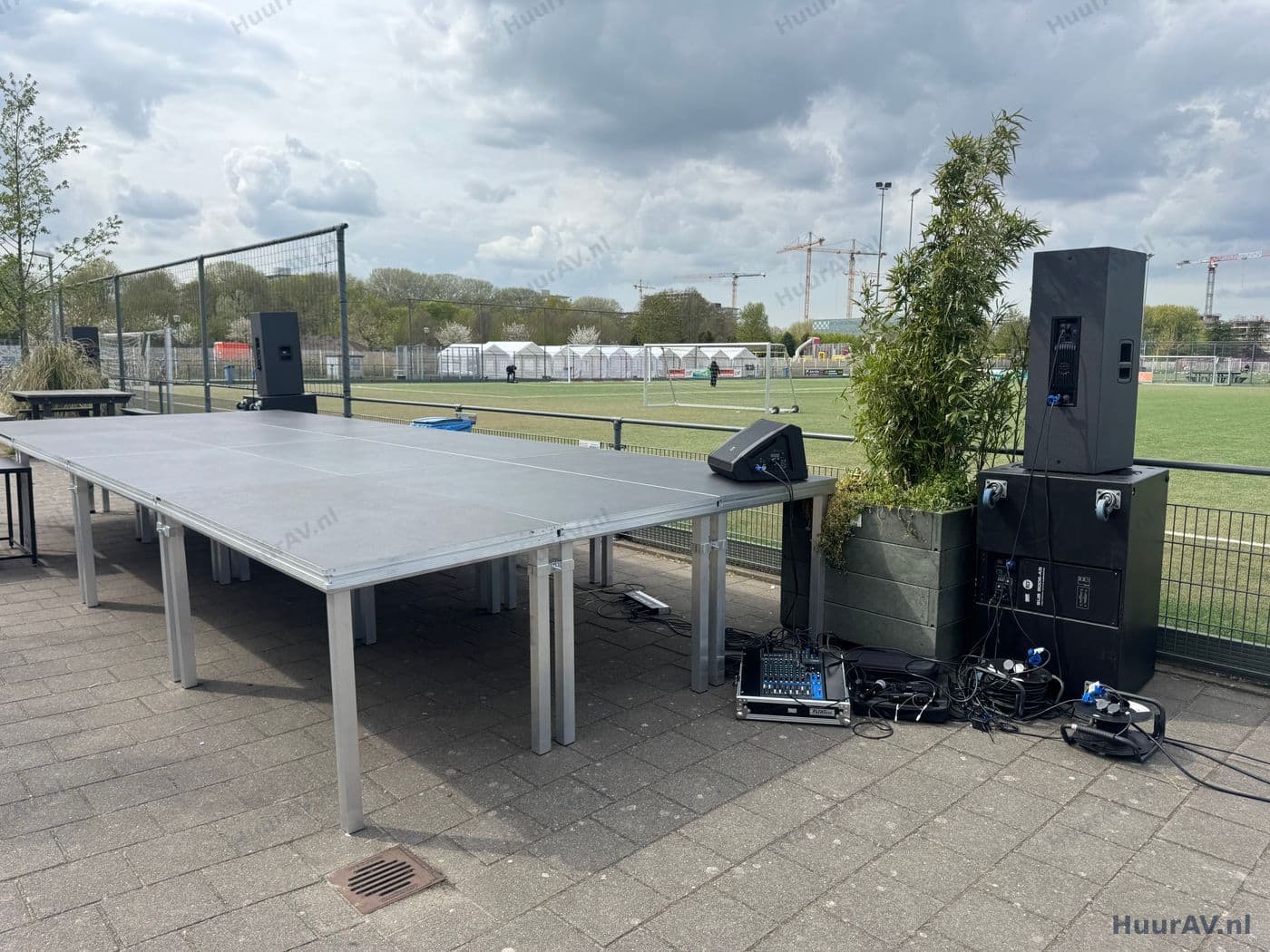
What speakers do and where you use them
Speakers, or loudspeakers, turn the electrical signal from a microphone, mixing desk or music source into sound that fills the room. They are the final and most audible part of any audio chain: however good your source is, in the end the speaker decides whether the audience understands a speech and whether the music sounds pleasant. That is why we never choose them as standard, but always based on the space and the crowd.
The uses are wide-ranging. For a speech or presentation you mainly want clear, focused reproduction of the voice. For a party or a live band you want power and a full low end instead. Between those extremes lies a large grey area, and that is exactly where the right choice makes the difference between sound that stays in the background and sound that carries all evening. Speakers are a core part of any sound setup and always work together with sources, microphones and a mixing desk.
Active or passive
The most important distinction is between active and passive speakers. An active speaker has the amplifier built in. You connect a signal cable, add power, and you are ready. That makes active speakers ideal for standalone events, quick setups and situations where you want the flexibility to move things around. A passive speaker has no amplifier of its own and is driven by a separate power amplifier in a rack. That requires more cabling and know-how, but for large or permanent setups it gives you more control over power distribution and reliability.
For most of the events we handle, active speakers are the logical choice. For larger productions, line-array setups or situations where many speakers have to work together, we more often turn to passive systems with central amplification.
When to use which speakers
The right speaker starts with the question: who is listening, and to what? A few concrete situations make that clear.
At a presentation or conference, everything hinges on intelligibility. The speakers have to spread the voice evenly across the room, right to the back row, without it becoming too loud at the front. A neatly sized stereo pair on stands is often enough for a medium-sized hall; for a wide or deep space we add extra speakers to make the coverage complete.
At a company party or reception, the emphasis shifts to music. Here you want speakers that deliver power and can carry the low foundation, usually complemented by a subwoofer. The sound has to be full and warm on the dance floor while it stays comfortable to talk at the bar. We manage that balance through the setup and the tuning.
At a corporate event with a mixed programme of speakers, video and a closing party, we choose a system that can handle both worlds: clear enough for speech, powerful enough for music. That avoids having to switch over halfway through the day.
And at a wedding, subtlety plays a big part. Ceremony sound and background music during the day, a dance floor that hits hard in the evening. We tune the speakers so that each moment gets the right dynamics, from a whisper-soft speech to an exuberant party.
The technology: setup, tuning and operation
Setup
A good setup begins with placement. Speakers belong in front of the audience, not behind it, and aimed at the listening area. We usually work with stands or, in larger halls, with flown or stacked configurations. Height matters: too low and the sound is blocked by the first rows of people, too high and the top of the room gets too much. With a subwoofer, we determine the spot on the floor where the low end comes through most evenly.
Tuning and testing
Once the speakers are in place, the tuning follows. We set the levels, use an equaliser to correct for the characteristics of the room and make sure both speech and music sound their best. A hard room with lots of glass and concrete calls for different settings than a room with curtains and carpet. We also check that no feedback develops between the microphones and the speakers, and where the limit lies before it starts to howl. After that we run a test with the actual sources, so you can hear in advance how it will sound.
Rigging and timing
We set up well before the start, so there is time to test calmly before the first guest arrives. Cables are neatly tidied away and taped down where needed, so the setup is safe as well. The setup time depends on the scale: a compact stereo pair is up quickly, while a larger setup with several speakers and subs takes more preparation.
On-site operation
For a complete production, a technician stays on hand to watch over the speakers. A room sounds different empty than full, and a programme that switches from speech to music calls for adjustment. The technician keeps the levels balanced, makes corrections and ensures the sound is right all day. If you prefer to keep control yourself, we deliver the installation ready to use with simple controls.
Points to watch specific to speakers
A few things deserve extra attention. Do not underestimate the acoustics of the space: a reverberant hall can make an excellent speaker sound poor, and you solve that with placement and tuning, not with more volume. Watch the coverage too: one over-powered system at the front creates a racket in the first row and too little at the back. A good distribution is often more important than more power.
Also think about power. Active speakers and subs draw current, and for larger setups we look at the available circuits on location in advance, so nothing cuts out. And bear the audience itself in mind: people absorb sound, so a full room sounds different than during the test. We adjust for that on the day itself.
Combining with lighting, video and effects
Speakers rarely stand alone. At most events they work together with other disciplines, and that makes coordination all the more important. If you are providing speakers and video, the sound of a film or presentation has to blend seamlessly into the same installation, so there is no difference in volume or delay. Our range for video connects to it directly.
Lighting and sound reinforce each other too. At a party, you want the speakers and the lighting to build the atmosphere together towards the highlight of the evening. And when you work with special effects, such as confetti or low fog at a climax, the impact lands hardest when the sound comes through in full at exactly that moment. By tuning the disciplines to one another, you create one experience rather than separate parts.
Practical tips
Think early about the most demanding moment of your event and size the speakers for that, not for the average. Share the floor plan and the number of guests as early as possible, because that lets us really calculate the coverage. If you are unsure about a subwoofer, let us know what you have in mind; for pure speech it is often unnecessary, for a dance floor almost always needed. And set aside time for a proper test with your own music or presentation, so you are not caught out by surprises.
For small gatherings where you want to collect and set up a compact kit yourself, you can rent individual speakers online directly through SpeakerVerhuur.nl. HuurAV is part of Speaker Verhuur Amsterdam and also provides the complete on-site service.
Request a no-obligation quote
Do you want to be sure that everyone can understand your speech and that the music sounds great all evening? Tell us about your space, your audience and your programme, and we will advise the right speakers and take care of the setup, tuning and operation on location. Request a no-obligation quote and we will put together a fitting proposal for you.
Renting speaker rental
What is the difference between active and passive speakers?
An active speaker has the amplifier built in, so you can connect it straight to the mixing desk or a source. A passive speaker is driven by a separate power amplifier and is popular for larger, permanent setups. For most standalone events, active speakers are the most convenient; for large or complex productions we often work with passive systems because they let you distribute power more precisely.
How many speakers do I need for my room?
That depends on the floor area, the shape of the space and the number of guests. A reception for fifty people calls for something quite different from a conference for four hundred visitors. We calculate the coverage and decide whether a stereo pair is enough or whether you need extra speakers to fill the room evenly. Tell us about the space and the audience and we will advise the right number.
Do I also need a subwoofer?
For speech, presentations and background music, a subwoofer is usually not needed. Once you have a party, a dance floor or a live band, a sub adds the low foundation that makes the sound full and warm. We advise, based on your programme, whether a sub adds value and which size fits.
Can I collect and set up speakers myself?
Yes, you can rent individual speakers online directly through SpeakerVerhuur.nl. If you would like us to handle the setup, tune it and operate it during the event, we arrange that in full with a technician on site. We recommend the latter for larger rooms or important moments.
Do you also handle the operation on the day itself?
We can. For a complete production we place a technician who sets up the speakers, watches the levels and makes adjustments as the room fills or the programme changes. That keeps the sound balanced all day and means you do not have to touch the technology yourself.
Renting speaker rental for your event?
Tell us what you are organising. We advise, deliver, build and operate on location, or you rent it yourself through our webshop.