
Rent projectors
A projector puts your presentation, video or live feed up large on a screen, provided the brightness, resolution and throw distance suit the room. We match the right projector to the size of the venue and the amount of ambient light, rig or place it neatly and connect every source cleanly. On site we test and operate the image, so your audience can follow along in sharp detail from the front row to the back.
What a projector is and what you use it for
A projector, sometimes called a beamer, casts an image through a lens onto a screen or a smooth surface. Where a television has a fixed size, a projector lets you scale the image from a couple of metres wide to a large screen that serves a whole venue. That makes projection the logical choice when you want many people to see the same thing at once: a presentation, a video, a live feed from the stage or an atmospheric backdrop.
The principle sounds simple, but the result stands or falls on three things: the brightness of the projector, the resolution of the image and the throw distance to the screen. A projector that puts out too little light delivers a washed-out, hard-to-read image the moment there is even a little ambient light. The wrong distance or lens gives an image that is either too small or spills over the edges of the screen. We balance these factors against one another, so the image sits on the screen sharp, bright and at the right size.
Brightness expressed in lumens
The brightness of a projector is expressed in lumens. The more lumens, the brighter the image and the better it copes with light in the room. A projector for a small, blacked-out meeting room needs far fewer lumens than one that has to fill a large screen in a bright venue. It is not a matter of always choosing as many lumens as possible, but of the right amount for your specific combination of screen size and ambient light.
When to use a projector
Projection is ideally suited to moments when many people need to watch at once and the image has to be large and clear. The projector is often the heart of the visual setup.
Concrete events
- Presentations and conferences: a large, bright image on which slides, speakers and videos are legible for the whole room. For presentations and conferences, projection is the most common way to let everyone follow along, right to the back of the room.
- Product launches: a wide screen on which your product, footage and the reveal moment appear on a grand scale. At a product launch, image quality largely determines the impact of the moment.
- Hybrid events and live streams: projection of the camera feeds and online participants in the room, so the on-site audience and the viewers at home follow the same thing. For hybrid events and live streams, we link the projector to the control desk so live and presentation images switch smoothly.
- Corporate events: from a kick-off to a year-end celebration, where the projector can show presentations as well as atmospheric visuals and video. At corporate events, we often use projection as the central visual source for the whole programme.
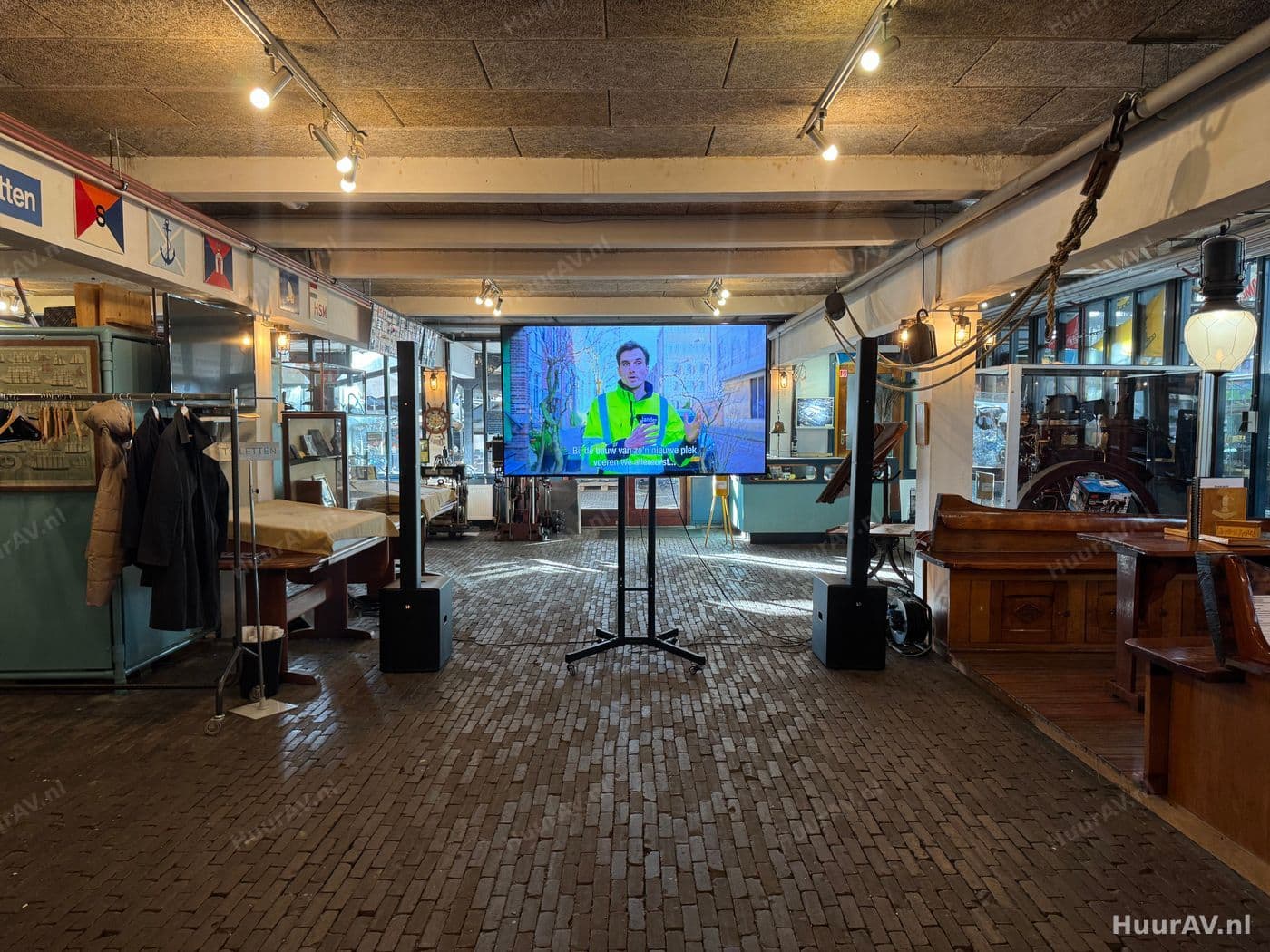
Where a lot of daylight comes in, or the image needs to stay compact, we sometimes advise a large TV screen instead of projection. Which is the best choice depends on the space, and we assess that case by case.
The technical side: setup, connection and installation
Behind a sharp image sits a series of choices we make in advance and on site. It comes down to placement, lens, cabling and a proper test before the first guest arrives.
Placement and throw distance
Where the projector stands or hangs determines how large and how straight the image falls on the screen. We calculate the throw distance in advance: the ratio between the distance from the projector to the screen and the width of the image. With a wide-angle lens we can create a large image from a short distance, while with a telephoto lens we project from the back of the room. The projector can sit on a stand or table, but we often rig it in a truss or from the ceiling, so it stays out of sight and clear of walkways. In doing so we watch the sightlines: the image must not be blocked by heads, lights or other equipment.
Screen and projection surface
Good projection calls for a good screen. A taut, even surface with the right properties holds contrast and brightness, whereas projection onto a rough or coloured wall loses image quality. We choose the screen size based on the venue and the viewing distance, and make sure the screen hangs taut so there are no creases or distortion in the image.
Connecting sources
The projector is only as good as the source feeding it. We connect laptops, media players, cameras and live stream feeds, usually via HDMI and, for longer distances, via professional signal cabling or converters that carry the image without loss of quality. If you are working with several speakers or sources, we place a switcher or vision mixer between the sources and the projector, so we can change over seamlessly without a black screen. All cables are laid away neatly and safely, including across walkways.
Setup, testing and operation on site
We set up well before the programme, aim the image precisely onto the screen and correct the geometry where needed so the edges sit straight. Then we test with the real sources: we check the sharpness, the brightness, the colours and whether all connections work. We also walk through the room to check that the image is legible from every seat. During the event our technician operates the image, switches between sources and keeps an eye on the projection staying sharp and bright throughout.
Points to watch specific to projectors
Projection has a few characteristics you need to bear in mind to get a good result. The most important are brightness, viewing distance and the light in the venue.
Brightness against ambient light
The biggest thing to watch with projectors is the balance between the brightness of the projector and the light in the room. Projection works with reflected light, and the more ambient light falls on the screen, the more contrast and brightness you lose. In a blacked-out venue a projector comes fully into its own, but as soon as daylight comes in or the house lighting has to stay on, you need a brighter projector. That is why we always determine the required number of lumens based on your space and not on a standard value.
Viewing distance and image size
The image has to be large enough to stay legible from the back row, but not so large that people at the front lose the overview. We match the screen size to the depth of the venue and the viewing distance of the audience. Text and detail-rich slides need a more generous image than atmospheric video. Resolution plays a part too: fine text and figures call for a sharp, high resolution so everything comes across clearly from every seat.
Balancing the light in the venue
Projection and house lighting have to work together. Bright direct light on the screen makes the image washed out, while a completely dark venue is unfavourable for speakers and interaction. We often look for a balance where the stage and the speakers stay lit while the screen picks up as little light as possible. We coordinate this with the lighting design, so image and lighting reinforce each other rather than working against one another.
Combining with lighting, sound and effects
A projector rarely stands on its own. The image is part of a whole in which sound and lighting also play a role, and it is precisely in that combination that a polished production comes together.
- With sound: an image without good sound does not land. For a video or a speaker, the sound has to be clear and intelligible and in step with the image on the screen. We make sure image and audio are in sync and that the volume is right throughout the room.
- With lighting: we match the house lighting and the stage lighting to the projection, so the screen stays bright while the speakers are still well lit. A well-considered lighting plan makes the difference between a washed-out and a sharp image.
- With special effects: for a reveal or an opening moment you can combine projection with atmospheric effects. Do watch the dosage, though, as too much haze or smoke can soften the projected image. Explore the options on the special effects page, and we will tune it to the visual setup.
The projector is part of our complete video offering, where we combine projection, TV screens and vision control into a seamless whole.
Practical tips for a sharp result
- Establish the ambient light first. Once you know how much daylight comes in and whether the house lighting has to stay on, we can choose the right brightness. This is the most important factor for a good image.
- Choose the screen size to the viewing distance. Measure the depth of the venue and account for the back row. Better an image that is slightly more generous than too tight.
- Deliver your content in good time. Slides, videos and footage in the right aspect ratio prevent black bars or cropped image. We check in advance that everything fits the screen properly.
- Account for the walkways. Cables and the placement of the projector partly determine the layout of the room. We lay everything away safely and rig the projector so no one walks into the beam.
- Test with the real sources. A test with the actual laptop or live stream immediately shows whether connections, resolution and brightness are right. We always do this before the guests arrive.
Renting projectors from HuurAV
If you want a presentation, video or live feed large and sharp on the screen, the right projector with the matching brightness and throw distance is the foundation. We choose the projector and lens that suit your space and ambient light, and take care of the setup, the connection of all sources and the operation on site. Whether it is presentations and conferences, a product launch or a hybrid event, we are happy to think along about how image, sound and lighting together deliver the result you have in mind. Request a no-obligation quote, and we will put together a fitting visual setup for your event.
Renting rent projectors
How many lumens do I need for my space?
That depends on the screen size and above all on the light in the room. In a darkened space a projector with fewer lumens is enough, but as soon as daylight comes in or the house lighting has to stay on for speakers, you need considerably more brightness. We determine the required number of lumens based on your room, the screen size and the ambient light, so the image always stays easy to read.
What is the correct throw distance for a projector?
The throw distance determines how large the image becomes and is set by the projector lens. For a short distance to a large image we use a wide-angle lens, while for projection from the back of the room we use a telephoto lens. We calculate the distance and the desired image size in advance and choose the projector and lens to match.
Can I use a projector when it is not completely dark?
Yes, provided the projector has enough brightness. In a venue where the lighting stays partly on for speakers or interaction, we choose a projector with sufficient lumens and a screen that holds contrast. With a lot of direct daylight, a large TV screen can sometimes be a better choice; we advise on whatever gives the best image in your situation.
Which sources can I connect to the projector?
We connect laptops, media players, cameras and live stream feeds via HDMI, and bridge longer distances with professional signal cabling or converters. If you are working with several speakers or sources, we place a switcher or vision mixer in between, so we can change over seamlessly without a black screen or dropout.
Can I rent a projector on its own without a technician?
HuurAV supplies projectors as part of a complete production with setup, testing and operation on site. If you want to collect and operate separate equipment yourself, you can arrange that online through SpeakerVerhuur.nl.
Renting rent projectors for your event?
Tell us what you are organising. We advise, deliver, build and operate on location, or you rent it yourself through our webshop.