
Speech reinforcement rental
Speech reinforcement comes down to one thing: every speaker must be easy to follow, clearly and effortlessly, right to the back of the room. That is not the same as loud sound, because intelligibility calls for careful tuning to the voice, the space and the audience. HuurAV builds speech reinforcement to measure, tunes it to the acoustics and operates the sound on site, so that every word lands, even in rooms that are difficult by nature.
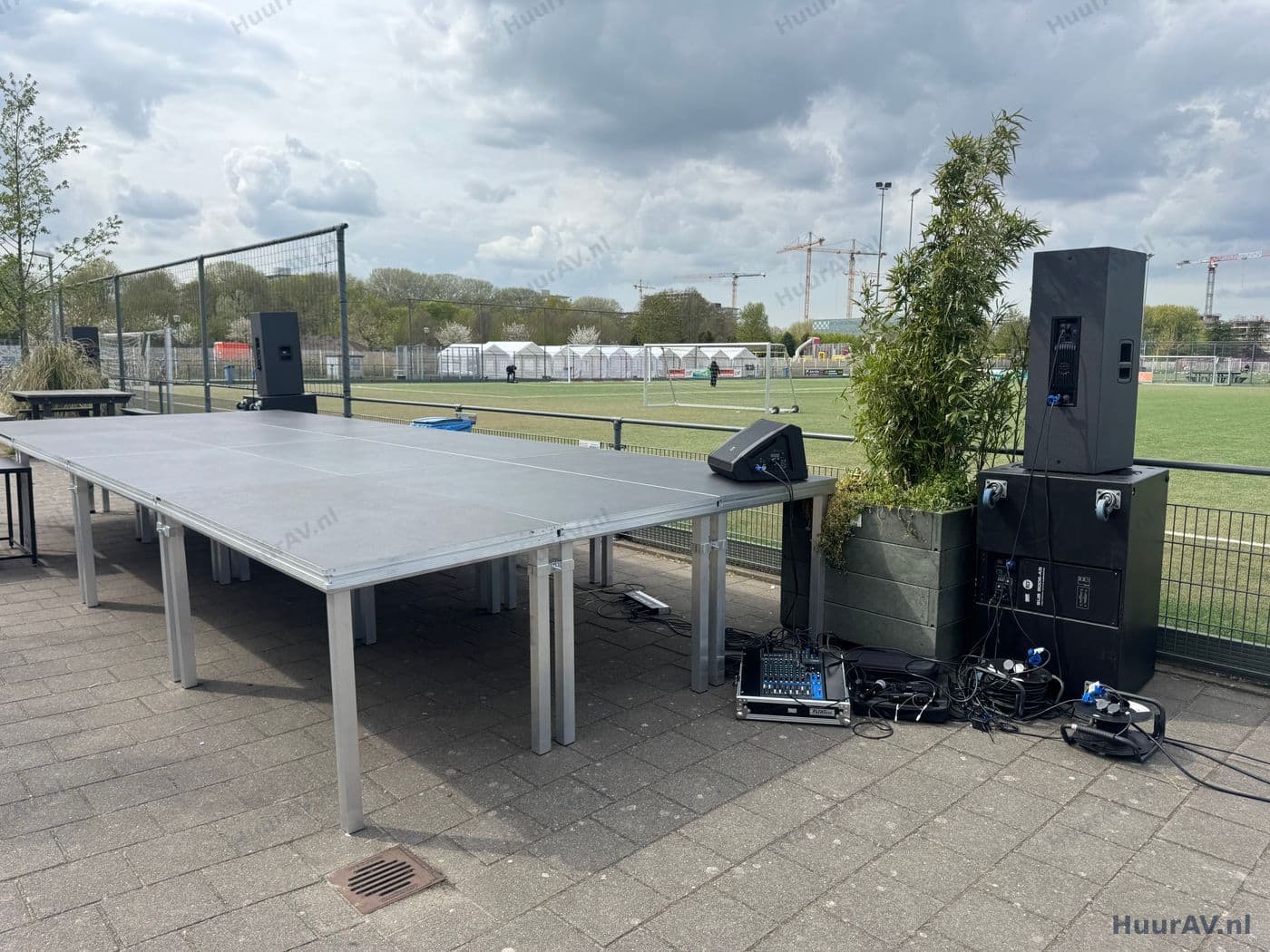
What speech reinforcement is and what you use it for
Speech reinforcement is sound engineering built for one purpose: making the spoken voice clear and intelligible everywhere in the room. That sounds obvious, but it is a craft in its own right. Intelligibility is not the same as volume. A voice can boom loudly through a hall and still be hard to follow, while a well tuned system at a comfortable level carries every word crystal clear. The difference lies in the tuning to the voice, the acoustics of the room and the way the sound is spread across the audience.
Where music reproduction is about a full sound picture with plenty of low end, speech puts the emphasis on the midrange, because that is where the human voice sits and where it is decided whether words come across recognisably. A system set up for speech focuses on clarity and on suppressing the reverberation and resonances that undermine intelligibility. That is why we put together a different configuration for a programme centred on the spoken word than we would for a party or concert.
Speech reinforcement belongs to the broader world of sound, where the microphone, the mixing desk, the amplification and the speakers together form a single chain. The microphone picks up the voice, but whether that voice ultimately reaches the room clearly depends on every link behind it and on how well the whole is tuned to the space.
Intelligibility as the starting point
The starting point for speech reinforcement is always the listener at the back of the room. If they can follow someone effortlessly without straining, the system is right. We work back from there: which speakers are needed, where should they go, how much amplification is required and what processing makes the voice full and clear without sounding unnatural. A softly spoken presenter calls for a different approach than someone with a powerful voice, and we set that up per person.
When to use speech reinforcement
Speech reinforcement comes into play as soon as the spoken word is central and the room or audience is too large to reach everyone without amplification. That happens at far more occasions than people expect, and it is often the very element on which an event stands or falls: if the speakers cannot be followed properly, everything else fades into the background.
Concrete events
- Presentations and conferences: keynote speakers, chairs and panels who need to stay clearly intelligible for hours to a full room. At presentations and conferences speech reinforcement is the foundation, often with several microphones for speakers and for questions from the floor.
- Ceremonies and weddings: a registrar, a ceremony host or guests giving a speech at a moment when everyone wants to follow word for word. At a wedding it also matters that the system is discreet and the voice comes across warm and natural, even outdoors or in a heritage building.
- Meetings and corporate events: members’ meetings, shareholder gatherings and kick-offs where speakers take turns and the room joins in. For corporate events we often run several channels side by side so handovers and questions flow smoothly.
- Parties with a spoken programme: hosts, presenters and speeches that hold a programme together. For parties and company parties we combine speech reinforcement with the music system, so speech and music run through the same control and the speech is not drowned out by the party sound.
For a short speech in a small room with a handful of people, amplification is often unnecessary. As soon as the space grows larger, the acoustics turn difficult or the audience expands, speech reinforcement is the difference between a message that lands and one that disappears halfway across the room. What you need in your situation is something we determine based on the space and the programme.
The technology: setup, tuning and operation
Behind speech that is effortless to follow all day sits more than a microphone and a speaker. It is about the right choice of microphones, thoughtful placement of the speakers, careful tuning to the room and a technician who safeguards clarity throughout the programme.
Choosing the right microphones
The chain begins at the microphone, and that choice already determines much of the result. For a speaker in a fixed spot a lectern or table microphone works well. For speakers who move around we choose wireless handheld, headset or lapel microphones, so they can move freely without having to think about the sound. For interaction with the room we bring in a microphone on a stand in the aisle or a throwable microphone that passes from hand to hand. For each programme we decide which combination best serves the speakers and the audience.
Placement of the speakers
Where the speakers sit is at least as important for speech as how many there are. We position them so the sound is spread evenly across the audience and bounces off the walls and ceiling as little as possible, because it is exactly those reflections that damage intelligibility. In a long or deep room we add extra speakers further along where needed, so the voice stays clear at the back too without becoming too loud at the front. Directional speakers help to put the sound precisely where the audience is seated.
Tuning to the room
Every room sounds different, and speech is more sensitive to those differences than music. We set up the system for the acoustics: reverberation, resonances and harsh frequencies that undermine intelligibility are ironed out, so the voice sounds natural and clear. At the mixing desk we set the amplification per microphone to the voice of the speaker in question and, where needed, apply light processing to the signal so a soft speaker comes through just as well as a loud one. With several speakers we match the channels to one another, so the volume stays consistent as someone takes over.
Setup, testing and operation on site
On the day itself we build up well before the start, run the cabling neatly and safely, and check the power supply. We then test the complete chain with a soundcheck and walk through the room to hear whether the voice comes through evenly everywhere and that no feedback develops anywhere. That way everything is up and running before the first guest arrives. During the programme our technician operates the mixing desk, opens and closes microphones at the right moment and keeps an eye on clarity and volume the whole time, so nothing goes wrong when a speaker talks more quietly or the room fills up.
Points to watch specific to speech reinforcement
Speech reinforcement has a few pitfalls that can be prevented in advance. Anyone who knows them keeps the message clear all day.
Feedback
The classic problem with microphones is feedback: the irritating squeal that occurs when a microphone picks up its own sound from the speakers again. This happens sooner with speech than with music, because the amplification is set higher to let a voice come through well and speakers are sometimes close to the speakers. We limit it by placing the speakers so they are not aimed directly at the microphones, by choosing directional microphones and by adjusting the critical frequencies on site. That keeps the voice loud and clear without it starting to squeal.
Reverberation and difficult rooms
Rooms with a lot of stone, glass or high ceilings, such as churches, heritage buildings and industrial venues, are notorious for their reverberation. Simply turning up the volume makes things worse there, because the reflections then grow louder too and undermine intelligibility further. The solution lies in directional speakers that send the sound to the audience, in extra speakers closer to the guests and in careful adjustment. It is precisely in those difficult rooms that bespoke speech reinforcement shows its worth.
Wireless frequencies and reliability
Wireless microphones work on frequencies that can be disrupted by other radio traffic in a busy environment. We scan the available spectrum on site and set up the channels so a panel or a group of speakers can all come through the system at once, free of interference. Fresh batteries or charged packs are standard, and for long programmes we keep spare transmitters ready to swap during breaks without interruption. That way no one drops out halfway through a speech.
Combining with lighting, video and special effects
A clearly intelligible speaker is the basis, but on a stage sound always works together with vision and atmosphere. When a speaker steps onto the stage, you want the lighting to move with the moment and light the speaker, so the audience naturally directs its attention to the right place and the speaker is well presented. A clear voice and a well lit speaker reinforce one another: the audience follows more easily what it both hears and sees.
If a presentation, film or livestream is shown, the sound of that video must run seamlessly through the same system as the speech, so there is no difference in volume or delay between what you see and what you hear. And for big moments you can link speech to special effects, for example a reveal or an entrance where an announcement, lighting and effect run exactly in sync. Because HuurAV supplies sound, lighting, video and effects from a single source, those elements connect to one another and everything follows the same running order without you having to coordinate different parties.
Practical tips
Share your programme as concretely as possible: how many speakers are there, are they in a fixed spot or do they move around, and does the room join in with questions? The sharper that picture, the better we can put the speech reinforcement together. Do not underestimate the room, because a hall that looks quiet during the day sounds very different with a full audience, and a reverberant venue always calls for more attention than you expect. With a tight programme, plan a moment for a short soundcheck with the actual speakers, because a voice sounds different in practice than in a test by the technician. And for speakers who move around, think in advance about where they can carry the wireless transmitter, so it is tidily and invisibly tucked away.
Loose equipment or a complete production
If you want to collect a compact set with a speaker and microphone yourself for a small gathering, you can hire loose equipment directly online through SpeakerVerhuur.nl, part of Speaker Verhuur Amsterdam. For an event where the speakers simply need to be easy to follow everywhere, choose the complete approach from HuurAV: we build the speech reinforcement to measure, tune it to the room, test everything on site and operate the sound during the programme.
Request a quote
Would you like to hire speech reinforcement for your presentation, conference, ceremony or meeting, with technicians who handle the setup, the tuning to the room and the operation on site? Tell us how many speakers there are, how they use the space, whether the room joins in and what kind of venue you have, and we will put together a fitting proposal. Request a quote with no obligation and we will think along with you about the best setup for clear, intelligible speech at your event.
Renting speech reinforcement rental
What is the difference between speech reinforcement and an ordinary sound system?
A sound system is the broader setup that can reproduce both speech and music. Speech reinforcement is a configuration set up specifically for the intelligibility of the spoken voice. Music is about a full sound with plenty of low end, while speech is about clarity in the midrange where the voice sits. That is why we tune the amplification, the placement of the speakers and the processing of the signal very differently when the goal is intelligibility. A system that sounds great for music is not automatically the best choice for a long speech or a meeting.
Does speech reinforcement also work in a reverberant or difficult room?
Yes, and that is exactly where good tuning makes the difference. In a reverberant space such as a church, a heritage building or a room with a lot of stone and glass, the sound bounces off the walls and intelligibility is lost if you simply turn up the volume. In that case we choose directional speakers that send the sound towards the audience and away from the walls as much as possible, place extra speakers closer to the guests where needed, and adjust the critical frequencies. That keeps the voice clear despite the acoustics of the room.
How many microphones come with speech reinforcement?
That depends on your programme. For a single speaker at a lectern one microphone is often enough, but a panel discussion, a ceremony with several speakers or a meeting with questions from the floor calls for more. We match the number and type to what happens on the day: a lectern or boundary microphone for the fixed position, wireless handheld, headset or lapel microphones for speakers who move around, and where useful a throwable microphone for questions from the audience. That keeps every handover running smoothly.
Can the audience ask questions through the system as well?
Yes. For interaction with the room we often add extra microphones, from a fixed microphone on a stand in the aisle to a throwable cube microphone that passes from hand to hand. Our technician opens and closes those at the right moment and keeps the balance in check, so a question from the floor is just as intelligible as the speaker on stage. That keeps a Q and A session or discussion easy for everyone to follow.
Can I also hire the equipment for speech reinforcement separately?
HuurAV supplies speech reinforcement as part of a complete production, including tuning to the room, testing and operation on site. If you would rather collect and set up loose equipment such as a speaker with a microphone yourself, you can arrange that online through SpeakerVerhuur.nl, part of Speaker Verhuur Amsterdam.
Renting speech reinforcement rental for your event?
Tell us what you are organising. We advise, deliver, build and operate on location, or you rent it yourself through our webshop.