
Rent spotlights
Spotlights put exactly the one point in view where attention needs to go: a speaker, a product on a plinth or the centre of a stage. Where ambient light colours a whole room, a spot draws a tight, contained beam around a single subject and deliberately leaves the rest in the dark. We handle the lighting design, the positioning, the focusing, the test and the operation on site.
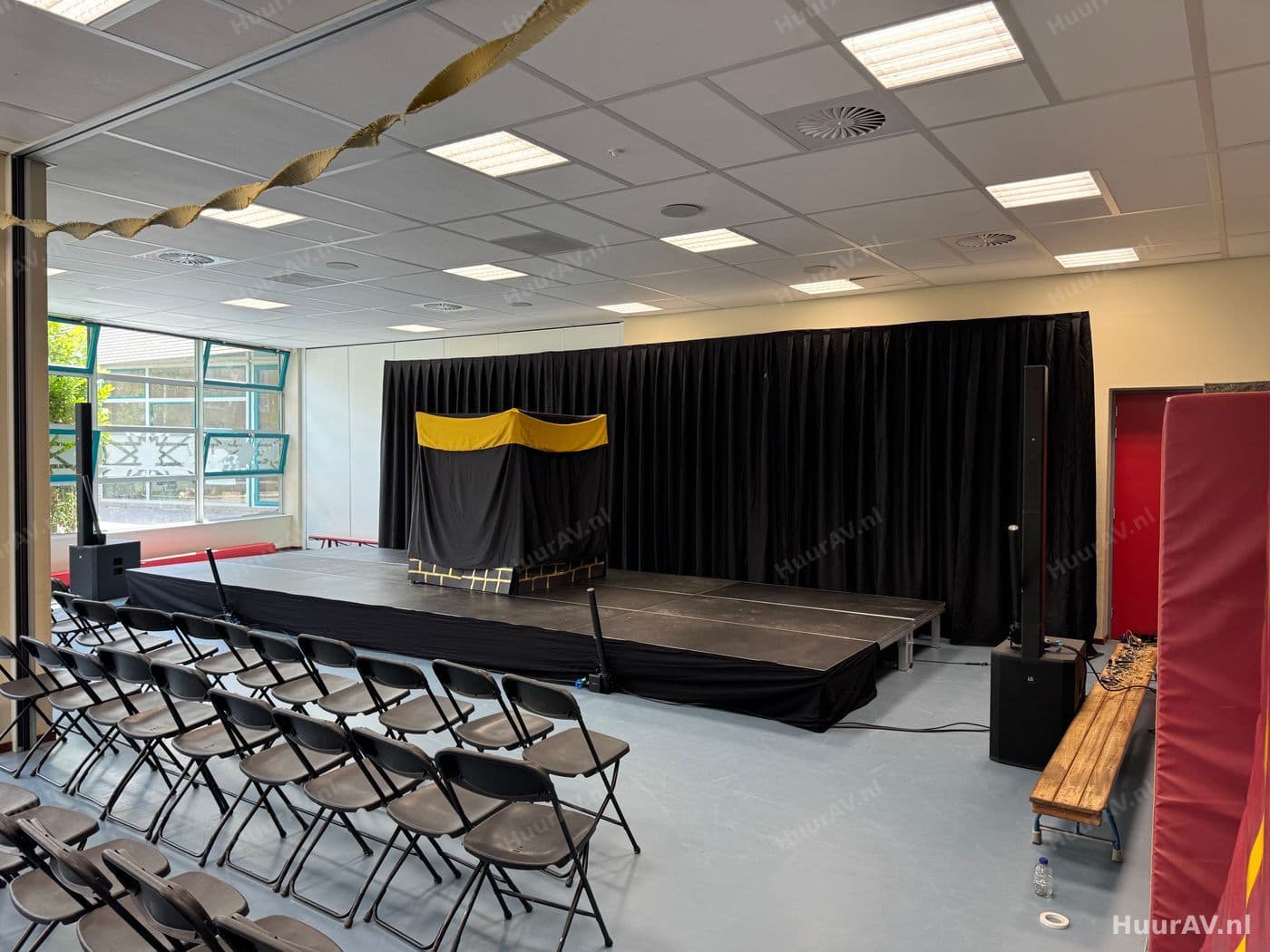
What spotlights are and the mood they create
A spotlight is a fixture that concentrates its light into a focused beam instead of spreading it across a whole room. Where much lighting is meant to fill a room evenly, a spot does the opposite: it seizes on a single point and lets the surroundings deliberately fall away. That contrast between light and dark is exactly what makes a spotlight so powerful. Your audience’s eyes naturally follow the light, so everyone looks at the same subject at the same moment.
The mood a spot creates is one of focus and importance. Anything that is picked out gains weight: a speaker who emerges from the dark, a product glowing on a plinth, or the centre of a stage that suddenly becomes the only place where something is happening. That theatrical effect is no accident; it is the same language used in theatres and on stages to guide attention. That language works at an event too, whether you want to make a moment feel grand or keep it understated and refined.
Within the family of focused spots there is a distinction between an ordinary spotlight and a profile spot. A spotlight gives a round beam whose edge we can make softer or harder. A profile spot goes a step further: with internal shutters and an iris we trim the beam into a tight circle, a narrow strip or a rectangle. That lets us stop the light precisely at the edge of a painting, a lectern or a logo, without any spill. That precision is the big difference from broader forms of lighting.
When to use spotlights
Spotlights come into their own wherever attention needs to go to a single point. At presentations and conferences we light the speaker on stage in a focused way, so they stand out clearly and separate from the background. That helps not only the audience in the room but also ensures the speaker looks good on screen if you record or stream the whole thing. A lectern, a panel setup or a keynote position almost always calls for some form of focused lighting.
At a corporate event you often use spots for a product launch or reveal. The product stands in the dark and, at the climax, is caught in a tight beam, so the moment naturally gets the attention it deserves. The same principle works at an award ceremony, where the spot follows the winner on stage, or at an opening where someone cuts a ribbon.
At a party or company party we use spots to accent a DJ booth, a performer or a specific part of the stage, or to light up a cake, an act or a surprise at the peak of the evening. And at a wedding a soft, warm spot can lift the couple out of the rest of the room during the first dance, or light the ceremony spot so precisely that all eyes gather there. You also see spots at exhibitions, anniversaries, galas and anywhere objects or people call for focused attention.
Speakers, objects and the stage
The subject determines the approach. A speaker calls for lighting that flatters the face without harsh shadows and without dazzling. An object, such as a product or an artwork, calls for a tightly contained beam that accentuates its shape and lets the rest fall away. Lighting a whole stage with spots means we balance several beams against one another so there are no dark gaps for someone to disappear into. For each of those situations we choose a different type of spot, a different angle and a different beam width.
The technology behind spotlights
Setup and position
The position of a spot determines almost everything about the result. For a speaker, light coming diagonally from the front and above works best, because it lights the face naturally and keeps the eyes out of shadow. Light straight from the front makes a face look flat, and light too far from the side gives harsh shadows. For objects we deliberately choose an angle that lets the shape speak, sometimes a little more from the side to show relief and depth.
We hang spots on a truss, put them on stands or place them on the floor, depending on the room and the height available. The distance to the subject determines how large the pool of light becomes and how tightly we can contain it. We make this kind of choice on site, because the ceiling height, the depth of the stage and the position of the audience differ from one room to the next.
Control via DMX
Our spots can be controlled via DMX, the standard protocol for stage and event lighting. With it we set the brightness per spot or per group and, on fixtures that support it, the colour and the beam shape. More importantly, we record scenes: a series of fixed settings that belong to different moments in the programme. That way we can bring up just the stage at the opening, set the spot tight on the object during a reveal, and glide smoothly from one position to another when speakers change over. We drive those transitions by hand or programme them in advance, so they arrive at the right moment.
If you want to approach lighting as a broader whole, with ambient light and accents alongside the focused spots, take a look at our options for lighting. Spots are often the layer you add on top of a base wash to bring in direction and focus.
Setup, focusing, testing and operation on site
On the day itself we hang or place the spots according to the plan and focus them one by one on their target. That focusing is precision work: we set the beam width, trim the edges with the shutters on a profile spot and make sure the pool of light falls exactly where it should. A test always follows, in which we put a person in the speaker’s position or set out the object and check that the lighting is right. We watch for dazzle, for shadows and for the transition into the dark around it.
During your event we can handle the operation ourselves, so the scenes and transitions run at the right moment and a follow spot is guided smoothly. For a simpler setup we set everything and briefly explain how to switch a scene yourself. What works best depends on the scale and flow of your programme. For a programme with several speakers, changeovers and moments, there is usually a technician on hand to let the lighting run along with the rest of the evening.
Points to watch specifically for spotlights
A few things determine whether spots really do their job. The most important is dazzle: a spot that is too bright or at the wrong angle leaves a speaker squinting into the light or has the audience looking into the beam. That is why, when focusing, we pay extra attention to the angle and the brightness, and always test from the subject’s own position.
Ambient light also weighs heavily. The contrast that makes a spot so powerful disappears in a bright, evenly lit room. The more you can dim the rest of the light, the more the lit point stands out. So we agree in advance how the room lighting can come down during the key moments. When a speaker is being filmed or streamed we also watch how the lighting reads on screen, because a camera responds to contrast differently from the eye.
Then there is the balance between sharpness and softness. A beam edge that is too hard can look clinical, while one that is too soft loses the contrast. For people we usually choose a slightly softer edge that lights flatteringly, and for objects or logos a tight boundary instead. And for a moving speaker we take freedom of movement into account: a fixed spot requires someone to stay in one place, while a follow spot can move along.
Combining with other disciplines
Spots work most strongly as part of a larger whole. Together with sound we make sure the moment someone steps into the light coincides with the moment the microphone and the music support it; light and sound peaking together make a reveal or an entrance far stronger. At presentations the lighting of the speaker often ties in with what is happening on screen, so we coordinate the spots with the video side of the production, so the speaker stays clearly in view and does not disappear against a bright projected image.
For an extra layer of effect we like to combine spots with special effects. A light layer of haze in the air makes the beam of a spot itself visible, so you see not only the lit point but also the shaft of light running towards it. That gives a theatrical, cinematic look that makes a real impression at reveals and entrances. Because we at HuurAV provide light, sound, video and effects within one production, these elements flow smoothly into one another on site, driven from a single plan.
Practical tips
Decide in advance which moment or which subject really needs the attention. A spot exists to make a choice, so the more clearly you know what should be picked out, the better the result. If you want to accent several moments, think about the order and let us prepare scenes for them.
Take ambient light into account. Ask whether your venue can dim the room lighting during the key moments, because that makes a big difference to how strongly the lit point stands out. Also share in advance whether a speaker stays still or moves, whether a product sits in a fixed place and whether the whole thing is being filmed, because that information determines the type of spot and the approach. And leave the focusing and fine-tuning to the setup on site: a plan on paper is only truly right once the beam falls in the room exactly where it should.
If you just want to collect and set up a single spot yourself, you can hire one separately via SpeakerVerhuur.nl. If you are after a fully managed result where the design, the setup, the focusing, the test and the operation are all arranged, HuurAV takes it entirely off your hands.
Renting spotlights from HuurAV
HuurAV provides spotlights and profile spots for events in Amsterdam and the surrounding area, from a presentation with a single speaker to a large product launch, always as part of a fully managed production. You tell us who or what needs to step into the light and at which moments, and we take care of the lighting design, the positioning, the focusing, the test and the operation. You do not need any technical knowledge for that. If you want to know what focused lighting could mean for your event, request a quote without obligation and we will think through the best approach with you.
Other lighting options
- Blinders
- Outdoor lighting
- Dance floor lighting
- DMX lighting control
- Gobo projection
- LED lighting
- Light shows
- Light strings
Renting rent spotlights
What is the difference between a spotlight and a profile spot?
A spotlight produces a round, focused beam with soft or slightly harder edges and is ideal for picking out a speaker or object. A profile spot goes further, with shutters and an iris that let us trim the beam into a tight circle or even a rectangle. That way we light exactly one logo, one painting or one speaker without the light spilling over the edge.
Can a spotlight follow a speaker who moves around the stage?
Yes. For a speaker who stays behind a lectern we set a fixed spot, and for someone who moves we can bring in a follow spot that a technician guides by hand. What works best depends on the room, the programme and how much the speaker moves around, and we agree that in advance.
Will a speaker end up squinting into bright spots?
That is exactly what we watch for when focusing. We place the spots at the right angle and distance so the face is nicely lit without anyone being dazzled. During the test we check this with a person standing in the speaker's position and adjust the angle where needed.
Can you set the spots differently at different moments in the programme?
Certainly. We record a scene for each part of the programme: just the stage in view at the opening, the spot tight on the object during a product reveal, and a calmer look during a break. Through DMX we switch between those scenes at the right moment, by hand or programmed in advance.
Can I also hire spotlights on their own without a technician?
For self-service hire without setup you can turn to our webshop SpeakerVerhuur.nl. If you would like us to design the lighting, place the spots, focus, test and operate them during your event, HuurAV takes care of that on a quotation basis.
Renting rent spotlights for your event?
Tell us what you are organising. We advise, deliver, build and operate on location, or you rent it yourself through our webshop.