
Video rental
From a projection screen or large display to a complete livestream and video recording. Sharp images that stay readable at the back of the room.
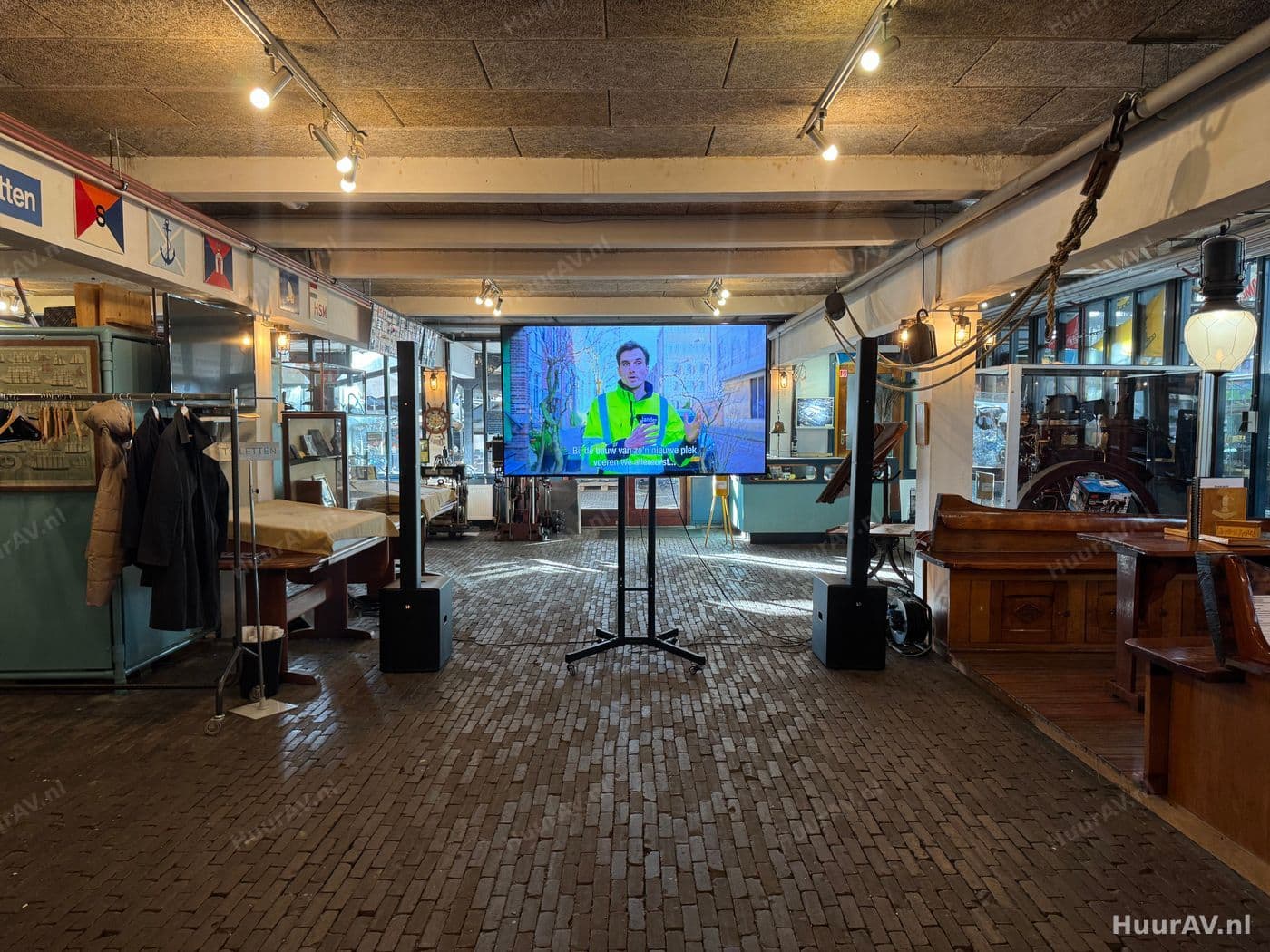
Video for every type of event
- Projectors
- Projection screens
- TV screens
- Large TV screens
- Presentation screens
- Live stream set
- Cameras
- Video recording
- Video switchers
- Confidence monitors
- Projection mapping
- Short-throw projectors
- Laser projectors
- Touchscreens
- Digital signage
- Freestanding displays
- Streaming encoders
- PTZ cameras
- Action cameras
- Media servers
- Teleprompters
- Wireless video link
- Displays on stands
Not sure which setup fits your room and audience? We advise and put together a complete plan. Rent equipment yourself via SpeakerVerhuur.nl.
Why a sharp, readable image strengthens your event
At an event, image is the medium that steers attention. Where sound makes your message audible, video makes it visible: a speaker’s slides, the logo at a launch, the close-up of a performer or the figures at a shareholder meeting. A sharp, bright and readable image draws the eye to the right moment and gives your programme a professional, refined look. An image that is too small, too dark or unreadable does exactly the opposite: guests disengage, the speaker loses their footing and the message does not land.
So when you consider video rental, it is about much more than a screen that happens to be big enough. It is about readability from every seat, about brightness that can stand up to the ambient light in the room, and about an image that moves seamlessly with your programme. A conference hall calls for text that is effortless to read even on the back row. A product launch calls for imagery that impresses and carries the atmosphere. A hybrid event calls for a stream that gives the viewer at home the same experience as the guest in the room. Each of these situations places different demands, and the art lies in matching to the room, the light, the viewing distance and the programme.
At HuurAV, an AV production company based in Amsterdam, we always approach video from that effect. We do not start with the equipment, but with the question of what needs to be seen, by how many people, at what distance and in what kind of light. From there we translate your wishes into a concrete image plan, handle the build-up and test, and run the video direction during your event so the image is right at every moment. That way all you have to do is enjoy the result.
The remarkable thing about image is that it works best when it seems self-evident. A well-chosen projection screen or large screen makes a presentation come across as clear and calm, as if it could not be any other way. It is only when the image falls short that it stands out: a presentation that fades against the room light, text that becomes unreadable at the back, or a stream that stutters at the most exciting moment. That is exactly why professional video rental is such a smart investment: it lifts the experience of your entire event, while the image itself does its work effortlessly.
Which video equipment you can rent
Video is a broad field, and it pays to know which building blocks you have at your disposal. Each type of equipment has its own function, and in practice we almost always combine them into a coherent whole. The art lies in choosing the right components for your situation and aligning them with one another. Below we run through the most important categories.
Projectors are the classic solution for a large image area. With a projector you cast an image onto a screen many times larger than any television, at relatively low cost. A projector’s brightness is expressed in lumens, and that brightness determines whether the image can stand up to the light in the room. Anyone looking for a powerful projector hire for a presentation or conference in Amsterdam chooses a projector that we match to the venue size, the viewing distance and the lighting situation, so the image stays bright and sharp.
Projection screens form the surface the projector projects onto. From a taut front-projection screen to a large cloth for rear projection: the choice determines how bright and high-contrast the image comes across. With the right projection screen you achieve a large, even image without wrinkles or light patches. We match the size and placement to the room and the sightlines, so every guest has a clear view and the image is easy to follow from the first to the last row.
Televisions are the practical choice for smaller spaces, reception areas, stand presentations and signage. A television is quick to set up, gives a bright image that stays readable even with plenty of ambient light and needs no blackout. With one or more televisions you bring content close to your guests, whether it is a welcome message, a programme overview or product imagery. For larger venues we combine them or move to projection or large screens.
Large TV screens give a bright, high-contrast image that convinces even in a well-lit room. Where projection appreciates blackout, large screens stay readable at full room light, which makes them ideal for presentations where the light needs to stay on. With large TV screens you achieve a crisp, professional look without projection’s sensitivity to ambient light. We advise per venue which size and setup gives the sharpest result.
Presentation screens are what we deploy on and around the stage, so speakers, panel members and the room see the right image in the right place. From a screen beside the speaker to displays that inform the room: well-placed presentation screens keep your programme clear and structured. They ensure attention goes to the right place at the right moment and that no one in the room has to miss anything.
Livestream set is the complete solution for bringing your event to an online audience. A livestream set comprises the encoder, the connection to cameras and image sources, and the link to the streaming platform of your choice. With a reliable livestream set you reach viewers who cannot be physically present, in stable, professional quality. We arrange the internet connection, the redundancy and the video direction, so the stream runs smoothly from start to finish.
Cameras bring speakers, performers and the audience into view, both for the room and for the stream. From a single fixed camera on the speaker to a setup with multiple angles for dynamic video direction: with professional cameras you capture every moment sharply. We match the number of cameras and the angles to your programme, so close-ups, wide shots and detail shots alternate and the viewer always has the best view.
Video recording captures your event for later use: an aftermovie, a rewatchable recording or footage for communication and marketing. With professional video recording you have a refined recording in hand afterwards that you can use again. We record multiple sources, from camera footage to presentations, so the recording is complete and of high quality and your event keeps its value after the day itself.
Video switchers form the command centre of the image. Here all sources come together, from laptops and presentations to camera feeds, and here the video director decides what appears on the screen and in the stream at any moment. With a good video switcher you switch fluidly between sources, add titles and logos and keep the image in hand all day. For programmes with many changes this is indispensable.
Confidence monitors are the screens that face the speaker, so they see their own slides or script in front of them without turning towards the projection screen. Without a confidence monitor a speaker loses their place or loses contact with the room. With confidence monitors your speaker stays in control and the programme runs smoothly, even with a tight script and many image changes.
Projection mapping, finally, is the technique with which you project image exactly onto a surface, whether that is a facade, a set piece or an object shape. With projection mapping you turn a neutral surface into a dynamic image canvas and give a launch, opening or party a surprising visual effect. It calls for precise preparation and alignment, and that bespoke work is exactly what creates a result that stays with your guests.
Choosing the right screen size based on viewing distance
Not every venue and not every audience calls for the same image. What is readable in a small meeting room disappears entirely in a large conference hall, and what fills an intimate space would vanish on a festival stage. That is why a good image choice always starts with two questions: how large is the space and how far away the furthest viewer sits. The answer determines the screen size, the brightness and the setup.
The viewing distance is the most important factor for the size. A common rule of thumb is that the distance to the furthest viewer should be at most six times the image height for text and detail, and roughly eight times for imagery that mainly needs to set a mood. Concretely: if the back row sits at fifteen metres and you want everyone to read the slides effortlessly, you need an image height of around two and a half metres. We calculate that in advance based on the floor plan, so the size is right and even the last row can follow everything.
The content on the screen determines how strict that rule is. A presentation with lots of text, small charts or figures calls for a larger and sharper image than a mood shot or a single logo. For a shareholder meeting with dense tables we choose a more generous size than for a party where the image mainly adds experience. So we match the size not only to the room, but also to what is actually being shown.
The sightlines in the room are the third determining factor. An image that is perfectly dimensioned but half behind a pillar or above the heads of the front rows still misses its purpose. We look in advance at the arrangement of the seats, the height at which the screen hangs or stands, and any obstacles, so every guest has a clear view. In wide venues we sometimes use multiple screens, so guests at the sides also have a good image.
To get this alignment right, we prefer to work with a floor plan and, where possible, a site visit on location. That way we map the sightlines and viewing distances in advance and prevent part of the room from being unable to follow the image well. Not sure which size suits your space? View projects to get a picture of the various venues and events we have handled, and get in touch to discuss your situation.
Projection or large screens: what suits your event
One of the most important choices in video rental is the one between projection and large screens. Both deliver a large image, but they do so in a different way and with different strengths. The right choice depends on the lighting situation, the desired size, the atmosphere and the budget.
Projection with a projector and projection screen is the solution when you want a truly large image area at relatively low cost. For sizes that a single screen cannot achieve, projection remains unmatched: a large cloth effortlessly fills a conference hall or party venue. The downside is the sensitivity to ambient light. Projection is at its best in a dimmed or blacked-out room, because bright room light reduces the contrast. With a powerful projector with enough lumens and good tuning we achieve a bright result even in trickier lighting, but the rule of thumb remains: the darker the room, the more convincing the projection.
Large screens and televisions reverse that ratio. They give a bright, high-contrast image that stays readable even when the room light is on, which makes them ideal for presentations where guests take notes or where the atmosphere calls for lighting. They are quick to build and need no blackout. The limitation is the size: a single screen does not reach the dimensions of a large projection cloth. For small to medium venues, reception spaces and presentations with a lot of ambient light, large screens are often the sharpest and most practical choice.
In practice we choose per venue and per programme. A dimmed theatre with a large hall lends itself perfectly to projection, while a bright meeting room or a reception space comes into its own better with screens. Sometimes we combine both: projection for the large main image and screens for the sides or the stage. We always advise, based on your space and goal, what delivers the sharpest, most readable and most refined result, so you do not pay for technology that your situation does not need.
Livestream and hybrid events
Since audiences cannot or do not always want to be physically present, the livestream has become a fixed part of many productions. A good stream is much more than a camera on a tripod: it is a full production in which image, sound and direction come together to give the viewer at home the same experience as the guest in the room.
With a livestream we bring your programme live into view on a platform of your choice, whether that is YouTube, Vimeo, a Teams or Zoom environment or a private portal. The core is the livestream set with encoder, supplemented by one or more cameras and a video switcher with which the video director switches between speakers, presentations and camera feeds. That way the online viewer gets not a static image, but a dynamic, refined broadcast in which attention keeps going to the right moment.
At a hybrid event you serve two audiences at once: the guests in the room and the viewers online. That calls for extra attention to both worlds. The presentation must be readable on the projection screen in the room and sharp in the stream at the same time, the sound must both fill the room and come through clean in the broadcast, and the video direction must account for what the online viewer sees. We build the hybrid setup so that neither audience is short-changed, with a video director who treats the stream as a full broadcast.
Crucial with any stream is the reliability of the connection. A stuttering stream at the most exciting moment does more damage than no stream at all. That is why we arrange a stable internet connection and, where it matters, redundancy via a second connection, so the broadcast keeps running even if something drops out. We test the stream in advance from source to platform, so on the day itself you know for certain that the viewer at home catches what happens in the room. Would you like a recording alongside the stream? Then with video recording we immediately provide a rewatchable version for later use.
How we work: from advice to video direction
Video rental at HuurAV is more than receiving equipment. You rent a complete way of working, in which we handle every step for you. That approach ensures you have nothing to worry about on the day itself and that the image looks exactly as intended.
It starts with advice. In a conversation we map out what kind of event you are organising, how many guests are coming, in what kind of space and with what light, and what needs to come into view. We ask questions you may not have thought of, about the viewing distance, the content of the presentations, the moments that need to stand out and whether there is an online audience. That conversation produces a clear picture of what is needed.
Next we make the image plan. That is the translation of your wishes into a concrete plan: which screens or projection, which size, which cameras, which switcher and which setup suit your space and programme. We determine the sightlines, calculate the size based on the viewing distance and choose components that are aligned with one another. That way you know in advance exactly what you get and why.
On the day itself we handle the build-up. Our team places or hangs the screens and projection, sets up the cameras, tucks away the cabling neatly and makes sure everything looks refined. We work clean and structured, because cables in the walkways or stands in the sightlines undermine any professional look. Everything is tucked away and nothing stands in the way of your guests or the sightlines.
Then comes the test. This is the moment the image comes to life. We check every source, from laptop to camera, test the transitions on the switcher, walk through the room to check the readability and the sightlines at every spot and, for a livestream, test the connection from source to platform. When there are speakers, we prefer to run the check together with them, so everyone knows how it works and there are no surprises.
Finally, the video direction. During your event our video director runs the direction of the image: switching between speakers, presentations and cameras, titles and logos at the right moment, and keeping an eye on the stream. Each source gets the right image at every moment, the transitions run smoothly and if the programme changes or overruns, we simply move with it. You focus on your guests, we keep the image on course.
Practical matters we pay attention to
Behind a sharp image there is always a piece of technology and planning that your guests do not see, but that does determine whether everything runs flawlessly. We take these matters off your hands in advance, so there are no surprises on the day itself.
To begin with, we look at signal and cabling. Image has to travel reliably from the source, often a laptop or camera, to the screen and the switcher. Different laptops have different connectors, resolutions vary and long cable runs call for the right technology to carry the signal cleanly. We map out in advance which sources there are and provide the right connections and transitions, so no black screens or wrong resolutions occur at the moment it matters.
In addition, power and redundancy are a fixed part, especially for livestreams and larger productions. We map out in advance which circuits are available and distribute the load, so nothing fails while the programme is running. For streams that must not stutter, we provide redundancy via a second internet connection or backup source, so the broadcast keeps running even if something drops out. At outdoor locations without fixed facilities we arrange power and connection as well.
We also take timing and logistics into account. When can we get into the venue, how much time is there for build-up and testing, when must everything be ready and how does the tear-down afterwards go? We coordinate that planning with the location and with any other suppliers. Because we often provide sound and lighting too, we can align those disciplines and prevent double work.
Video as part of the overall picture
Video rarely stands on its own. At an event, image works together with sound, with lighting and with the set to form a whole. A speaker who is perfectly in view but poorly audible still misses their effect, and a beautiful projection that fades against bright room light stays unused. Precisely because as an AV production company we have all disciplines under one roof, we can align those parts with one another.
In practice that means the image moments connect to what happens in the sound and the lighting, that the lighting accounts for the readability of projection, that the build-up of the various disciplines is aligned and that one team runs the direction. For you as the client that saves coordination, multiple contacts and the risk that disciplines work past each other. You have one plan, one point of contact and one team that ensures everything is right on the day itself. Would you like to see how that turns out in practice? View projects for an impression of previous productions.
Why choose HuurAV
There are plenty of parties where you can rent video, so why HuurAV? The answer lies in the way we work and what you notice of it on the day itself.
First, with us you have one point of contact. From the first advice to the last cable being cleared away, you speak with the same people. You do not have to tell your story over and over and nothing falls through the cracks. That gives peace of mind, especially when you are thinking about a hundred other things besides the image.
Second, there is always a technician and, where needed, a video director on site. We do not drop off boxes and then disappear. Our people build up, test, run the video direction and tear down again. That presence is exactly what makes the difference between technology that works and technology that carries your event.
Third, we steer on readability and sharpness. It is not about as large as possible for us, but about as readable as possible: a presentation that arrives clear everywhere, an image that can stand up to the room light and a stream that runs stable all day. That craftsmanship is where you see the difference.
Fourth, there is our base in Amsterdam. We know the halls, venues and locations in and around the city, are quickly on site for a survey or test and work from there throughout the Netherlands. Those local roots mean short lines and plenty of experience with exactly the kind of events you organise.
We work from a complete AV perspective, which means we do not see video as a separate part but as part of the overall picture, together with sound and lighting. If you only want to collect equipment without build-up and operation, self-service rental is possible through our webshop SpeakerVerhuur.nl, the webshop of Speaker Verhuur Amsterdam, where you can go without a technician. For everything that involves advice, an image plan, build-up, testing and video direction, HuurAV handles the complete process on a quotation basis.
Getting started with your video
Whether you want to bring a conference clearly into view, make a presentation readable everywhere, give a launch a visual punch or stream a hybrid event professionally, the right image makes your event complete. Video is not a side issue but one of the strongest means you have to steer attention and strengthen experience, and with the right image plan, a thorough test and video direction on site you get everything out of it.
Would you like to rent video for your next event in Amsterdam or beyond? Tell us what you have in mind and we will think along about the best approach and calculate a fitting scenario for you. Request a quote free of obligation, and after a short conversation you will know exactly what we can do for you. We look forward to bringing your event into view, sharp and readable.
Frequently asked questions
What does it cost to rent video for an event?
The price of video rental depends on the size of the venue, the number of guests, the viewing distance and whether you choose projection, large screens or a livestream. A projector with a projection screen for a presentation is a different investment than a setup with multiple cameras, a video switcher and a livestream set for a hybrid conference. We always create a tailored quote, so you know exactly what you get and why. Request a quote free of obligation and we will calculate the scenario for you.
Does a technician or video director come along on site?
Yes, for projects we handle there is a technician on site as standard, and for livestreams or programmes with multiple image sources a video director as well. They build the screens and projection, test the signal from laptop to screen, and run the video direction during your event: switching between speakers, presentations and cameras. That way the image is right all day. If you only need equipment without operation, self-service rental is also possible.
How large does my screen need to be for the venue?
That depends mainly on the viewing distance. A common rule of thumb is that the distance to the furthest viewer should be at most six times the image height for text and detail, and eight times for imagery that mainly needs to set a mood. For a venue where the back row sits at fifteen metres, you quickly arrive at a large projection screen or a large screen. We calculate the size in advance based on the floor plan, so even the last row can read everything effortlessly.
Can you provide a livestream or hybrid event?
Certainly. We provide complete livestreams and hybrid events where your in-room audience and your online audience are served at the same time. With a livestream set, multiple cameras, a video switcher and a reliable internet connection we bring your programme professionally to platforms like YouTube, Vimeo, Teams or a private environment. The video director switches live between sources, so the viewer at home gets the same experience as the room.
What is the difference between projection and large screens?
Projection with a projector and projection screen delivers a large image area at relatively low cost and is ideal for dimmed venues and large formats. Large screens and televisions give a bright, high-contrast image that stays readable even with a lot of ambient light and are quick to build. Which choice fits best depends on the lighting situation, the desired size and the atmosphere. We advise per venue what gives the sharpest and most readable result.
Do you have confidence monitors for speakers?
Yes, we place confidence monitors so your speaker sees the presentation or the script in front of them without having to turn towards the projection screen. That keeps the speaker in contact with the room and the presentation smooth. Combined with good video direction and presentation screens on the stage, your programme keeps running professionally and without hitches, even with a tight schedule and many changes.
How far in advance should I book video?
For an average event we advise getting in touch a few weeks ahead, so there is room for advice, an image plan and a test. For livestreams and larger productions with multiple cameras and video direction that preparation is extra valuable. During peak season the calendar is full, so booking early gives the most certainty. If you need something at short notice, feel free to reach out, as we often still find a suitable solution.
From request to breakdown
- Step 01
Intake and inventory
We discuss your programme, your venue and what really has to go well. You do not need any technical knowledge. We ask the questions that matter.
- Step 02
Technical proposal and quote
You receive a clear plan with the complete setup for sound, video, lighting and livestream if needed, plus a transparent quote.
- Step 03
Planning with venue and parties
We coordinate with the venue and others involved: build times, loading route, power and the run sheet. Everything is set in advance.
- Step 04
Delivery, setup and full test
We deliver, build and test everything well before the start. Every microphone, screen and connection is checked.
- Step 05
On-site support, breakdown and review
A technician is present during your event. Afterwards we break down neatly and briefly review what went well.
Video for your event?
Tell us what you are organising and we will propose the right setup.