
Stage monitor rental
A monitor is the speaker or earpiece that lets someone on stage hear themselves and the rest, so speaking and playing stay confident and on tempo. HuurAV chooses between floor wedges and wireless in-ears based on your programme and stage, and tunes every monitor mix on site for each person. That way everyone on stage hears exactly what they need, without feedback and without interfering with the sound in the room.
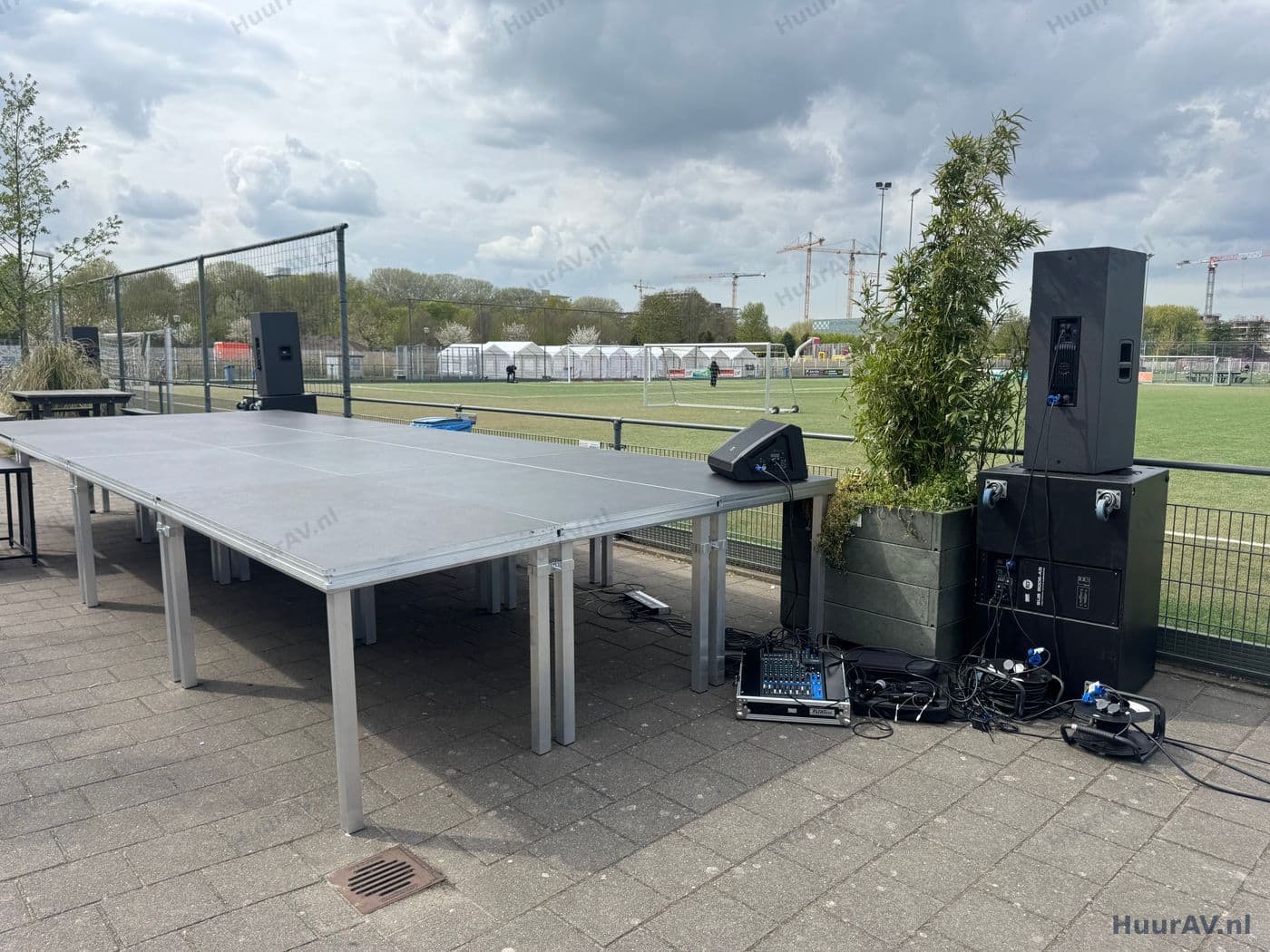
What a monitor is and what you use it for
A monitor is the sound that the people on stage hear back, and that is something entirely different from the sound the room hears. The speakers pointed at the audience deliver the full mix, but anyone standing on stage barely hears that mix: they are there with their back or side to it and mostly catch reverb and delay. A monitor solves this by giving the speaker or musician exactly what they need to stay confident. That can be a wedge, an angled speaker at the front edge of the stage, or a wireless earpiece that brings the mix straight into the ear.
You use monitors as soon as someone on a stage needs to be able to trust what they hear. For a speaker that means their own voice and possibly a count-in or a cue, so they hold the pace and do not start second-guessing. For a musician it means their own voice or instrument balanced against the rest of the band, so everyone plays tightly together. Without good monitoring people start compensating: speakers talk too loudly or falter, singers hunt for the note, and a band drifts out of time. A monitor removes that uncertainty and lets everyone on stage do what they are good at. Monitoring is therefore a fixed part of the sound setup and never stands apart from the rest.
Stage sound versus room sound
The most important thing to understand is that the stage is its own sonic world. The room needs to hear the full mix beautifully and clearly, but that is of no use to the performer: they need a mix tailored to them. Those two worlds rarely line up. A singer mainly wants to hear themselves clearly, whereas that same level is precisely what you do not want in the room. Good monitoring separates the two, so the stage gets exactly what it needs without getting in the way of the experience in the room.
When to use monitors
Monitors come into play as soon as there is a stage and people have to perform on it. At a presentation or conference a single wedge or a discreet earpiece is often already enough to give a speaker something to hold onto, especially on a large stage or in a room with plenty of reverb where their own voice would otherwise get lost. Speakers feel the difference straight away: they sound more assured and keep the pace more smoothly.
At a party or company party with a live band or an act, monitoring is not a luxury but a requirement for playing tightly. The band has to hear each other over the room sound, and that calls for wedges or in-ears. At a wedding, monitoring plays a role in live music during the ceremony or the reception, and in speeches where it matters that the person speaking can hear themselves clearly in an emotional moment. At a corporate event with speakers, a host and perhaps a musical interlude, good monitoring keeps everyone on stage at ease. In short: wherever someone stands on a stage and needs to hear themselves or the rest, monitoring deserves attention.
The technology: positioning, tuning, setup, testing and operation
A monitor only works well when it is in the right place and tuned per person. Stage sound calls for its own approach, because it demands care and the line with feedback runs close.
Positioning
Wedges sit at the front edge of the stage, tilted upwards towards the performer’s face. The placement is not casual: a wedge has to be outside the pickup angle of the microphone, so the monitor sound is not picked up again by the microphone and starts to howl. With several people on stage we distribute the wedges so that everyone has their own zone. If you opt for in-ears, the question of floor placement disappears, but a wireless connection is added that we have to set up reliably and free of interference. We choose the layout that suits the stage and the number of people on it per situation.
Tuning per mix
The heart of good monitoring is that each person gets their own mix. What the singer wants to hear differs from what the speaker or the guitarist needs. We build a separate monitor mix per person or per zone from the mixing desk: one gets mainly their own voice, another more of the band or a count-in. We then tune each mix for level and tone, and use the equalizer to cut away the frequencies that want to howl. With in-ears, everyone can also set their own level. That tuning happens during the soundcheck, in consultation with the people on stage, because only they can hear whether it is right.
Setup and testing
On the day itself we set up well before the start. We place the wedges or hand out the in-ears, route the cabling safely out of the way and check the wireless connections on a clean channel free of interference. Then comes the soundcheck, the most important moment for monitoring: we go through the mix per person, tune levels and, together with the performer, find the line where it is enough without starting to howl. We also test what happens when everyone plays or speaks at once, because that changes the balance. That way every mix is right before the first guest arrives.
Operation on site
During a programme the situation changes: a speaker who warms up often wants a little more, a band asks for an adjustment between numbers. For programmes with multiple mixes or a live band we recommend a sound engineer who watches over the monitoring separately and adjusts it per person, apart from the room mix. For a simple setup with a single wedge we set everything up well in advance and briefly explain how to adjust it.
Points of attention specific to monitors
With monitoring, things often go wrong on points you can head off in advance. The biggest is feedback: a monitor that is too loud or badly placed produces exactly that howling sound that can ruin a moment. The solution lies in placement outside the pickup angle and in careful tuning with the equalizer. In-ears remove much of this risk because there is no longer any open monitor sound on stage.
A second point is the number of independent mixes. Every separate mix requires an output on the mixing desk and time during the soundcheck. If we know in advance how many people are on stage and who wants to hear what, we make sure the desk can handle it. With in-ears you also watch the wireless frequencies: on a busy stage with plenty of wireless microphones and earpieces, every channel needs its own slot to prevent interference. Finally, monitoring is people’s work. The performer is the only one who can truly hear whether their mix is right, so a good soundcheck with engaged speakers or musicians is indispensable. Anyone who takes the time to tune together stands on stage far more at ease.
Combining with light, video and special effects
Monitoring works together with everything happening on stage. When a speaker or act stands in the light, a bright spot is often blinding and the performer can barely see the room; that is exactly when a good monitor gives the anchor the eye briefly misses. The sense of control on a lit stage comes largely from what you hear.
Monitoring also ties in with visuals. If a clip, a count-in or an announcement is running via video, the speaker or band often wants to hear that cue back in their own mix, so they come in at exactly the right moment. That same cue can be linked to a moment with special effects, and then it is important that the stage hears when the time comes. Because HuurAV delivers sound, light, video and effects from a single source, those elements dovetail and the monitor mix serves the whole programme, without you having to coordinate different parties.
Practical tips
Tell us in advance who is on stage and what they need to hear. A single speaker needs very different monitoring from a five-piece band, and the more concrete the picture you paint, the better we can determine the number of mixes, the wedges or in-ears and the mixing desk. Also let us know if there are speakers with little stage experience; for them a good, steady monitor is especially valuable.
Plan time for the soundcheck and make sure the people on stage are there for it, because only they can hear whether the mix is right. If you are torn between wedges and in-ears, choose in-ears as soon as freedom of movement, a quiet stage or ruling out feedback matter, and wedges when simplicity and familiarity come first. And if you want to collect individual equipment yourself for a small setup, you can hire it easily online via SpeakerVerhuur.nl.
Request a quote
Want monitors that fit your stage and the people standing on it precisely, tuned per person by our technicians so everyone hears themselves clearly without feedback? HuurAV, part of Speaker Verhuur Amsterdam, puts together a monitor setup on a quotation basis that connects to the rest of your sound, light and visuals. Let us know who is speaking or playing and what your stage looks like, and we will think along about wedges or in-ears and the number of mixes and send you a clear proposal. Request a quote with no obligation.
Renting stage monitor rental
What is the difference between a wedge and in-ears?
A wedge is an angled monitor speaker that sits at the front edge of the stage, tilted upwards, and gives the performer their own mix back. In-ears are wireless earpieces that deliver that same mix straight into the ear. Wedges are quick to set up and familiar for speakers and small bands, while in-ears offer more freedom of movement, keep the stage quiet and greatly reduce the risk of feedback. We advise per programme what suits best.
Do I need a monitor for a speaker as well?
Often yes, and it is underrated. A speaker who cannot hear themselves clearly starts doubting the pace, talks too loudly or too softly and loses their flow. A single wedge or a discreet earpiece solves that. Especially on a large stage, with a band also playing or in a room with plenty of reverb, good foldback makes the difference between a hesitant and a confident presentation.
Does a monitor prevent feedback?
A poorly set monitor is exactly where feedback often begins, so the tuning demands care. We place the wedges outside the pickup angle of the microphones and use an equalizer to cut away the frequencies that want to howl. In-ears remove much of the problem, because there is no longer any open monitor sound on stage for the microphone to pick up again. That keeps the foldback clean and stable.
Can different people on stage each get their own mix?
Yes. Every musician or speaker wants to hear something different: the singer mainly their own voice, the guitarist more of the band, the speaker mainly their own microphone and a count-in. We build a separate monitor mix per person or per zone and tune it during the soundcheck. With in-ears, everyone can even set their own level, so no one has to compromise on what they need.
Can I collect and connect monitors myself?
You can hire individual equipment directly online via SpeakerVerhuur.nl and collect it yourself. If you want us to choose the monitors, set them up, tune them per person and watch over them during the programme, HuurAV arranges that on a quotation basis, including technicians on site. As soon as multiple mixes or in-ears come into play, we recommend that support, because that is precisely where the craftsmanship lies.
Renting stage monitor rental for your event?
Tell us what you are organising. We advise, deliver, build and operate on location, or you rent it yourself through our webshop.