
Large TV screen rental
Even in a well-lit room, a large TV screen delivers a bright, high-contrast image that stays sharp up close. Where a projector struggles with daylight or bright stand lighting, a television remains effortlessly legible. We choose the right size and placement for your space and viewing distance, and take care of the setup, connection, testing and operation on location.
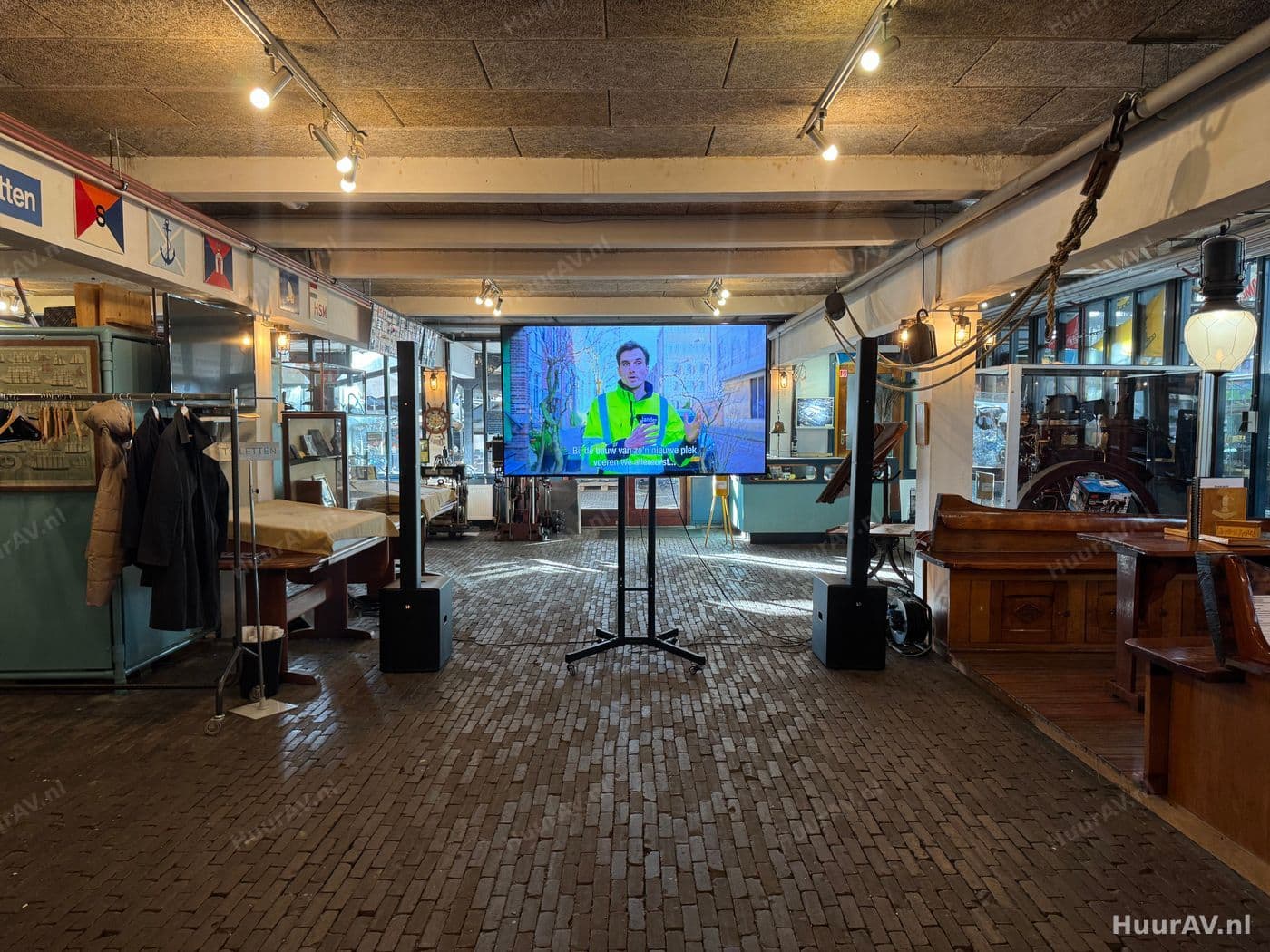
What a large TV screen is and what you use it for
A large TV screen is a professional television with a substantial diagonal that produces its own light. Unlike projection, where a projector throws light onto a screen, a television emits the image itself. That makes a crucial difference as soon as there is plenty of ambient light. In a bright hall, a room with large windows or on a trade fair floor with strong ceiling lighting, a TV screen stays bright and high in contrast, whereas a projected image quickly turns washed out and hard to read in those same conditions.
That is exactly where a large TV screen fills the gap that projection leaves open. You use it when blackout is not possible or not wanted, when people stand relatively close and you want a crisp, deep image, or when you need a compact, quick-to-build solution that still looks polished. Choosing between a television and projection is therefore not a matter of right or wrong, but of picking the right tool for the conditions. For a darkened room and a large group, projection is often the more logical choice, but with lots of light and a shorter viewing distance, the TV screen wins on brightness and ease of use.
Where the screen shows its strength
The strongest quality of a large TV screen is its contrast in bright light. Deep blacks, saturated colours and a sharp image that does not turn grainy even up close: these are the qualities that set a television apart. For content that depends on detail and colour, think of product imagery, a menu with small text or a continuous ambient video on a stand, that is a major advantage. The image stays calm and legible, regardless of the light in the room.
When to use a large TV screen
A large TV screen comes into its own in situations where light plays a role and the audience is not too far from the image. We determine the size and the number of screens for each situation.
Concrete events
- Trade fairs and exhibition stands: this is the ideal place for large TV screens. A trade fair floor is almost always brightly lit, and that is precisely where a television holds on to its bright, appealing image. On a stand you can show a continuous product video, a presentation or a brand message that passers-by see straight away, without having to darken the space.
- Presentations and conferences: in a bright room or foyer where blackout is difficult, a TV screen keeps slides and imagery legible during a presentation or conference. For smaller breakout sessions or reception areas, a television is often more practical than a full projection setup.
- Product launches: at a product launch, a large TV screen shows the product sharply and true to colour, even when the room lighting stays on for atmosphere. The deep contrast lets product imagery come into its own.
- Corporate events: from an information market to a networking drinks reception, at a corporate event you can use TV screens for wayfinding, programme information, ambient imagery or a continuous presentation in a room where you would rather not dim the lights.
- Hybrid events and livestreams: at a hybrid event or livestream, a TV screen in the room shows the live image or the online participants, while the space stays brightly lit for the camera. Image and recording then reinforce each other.
In a larger or elongated room, we place several screens showing the same content so everyone keeps a good view. On a trade fair stand this can mean showing the same message in several spots, so visitors are drawn in from every angle.
The technology: setup, connection and operation
A good image on a large TV screen is mainly a matter of the right placement and a reliable signal chain. The components are straightforward, but the execution determines the result.
Setup and installation
We start with how the screen stands or hangs. Depending on the space and the desired image, we work with a mobile floor stand, a tripod, a wall bracket or a truss construction. Height matters: the bottom of the image sits high enough that people at the back also have a clear view over the heads in front of them. At the same time, the screen should not hang so high that viewers nearby have to crane their necks. We find the balance that suits the layout of the room.
Safety and a tidy overall look are part of the installation. A large screen has weight, so the construction is set up to be firm and stable and, where needed, anchored or weighted down. We tidy away the cables so there are no loose leads running across the floor and the whole thing looks clean, whether the screen stands on a stage or on a trade fair stand.
Connection
We connect the source, such as a laptop, media player or camera, to the screen via reliable cabling. We make sure the resolution and aspect ratio are correct so the image fills the screen neatly, without black bars or a stretched picture. When there is a greater distance between source and screen, we use signal amplification or cabling that carries the image without loss of quality. If several screens need to show the same image, we distribute the signal via a splitter so each screen runs perfectly in sync. Where multiple sources are needed, think of a presentation and a camera feed, we route them through a switcher or vision mixer so you can switch smoothly between them.
For a continuous presentation or product video on a stand, we can also play the image from a media player on a loop, so the content keeps running all day without any attention.
Testing and operation on location
Before the doors open, we test the complete image. We check sharpness, colour, brightness and aspect ratio, and we walk through the room to judge from various spots whether the image is clearly legible everywhere. With several screens, we check that they run in sync and match in colour reproduction. During the event, our technician can operate the image: advancing slides, switching between sources or driving the content. For a continuous setup, we make sure everything keeps running on its own, so you can focus on your guests.
Points to consider specific to large TV screens
A television has different strengths and weaknesses than projection. It is precisely those differences that determine when and how you use the screen.
Brightness and light in the room
This is exactly the reason to choose a TV screen. Because the television emits its own light, ambient light has far less effect on the image than with projection. In a bright hall or on a brightly lit trade fair floor, the image stays bright and high in contrast, where a projector would weaken. Even so, it remains wise to avoid direct, bright light shining straight onto the screen surface, because reflection can disturb part of the image. When positioning the screen, we pay attention to the angle relative to light sources and windows, so reflections do not get in the way of the image.
Viewing distance and size
A TV screen works best at a shorter to medium viewing distance. The size has to suit the distance of the furthest viewer: too small and the text becomes unreadable at the back, too large for a small room and the people at the front have to move their heads. We calculate the ideal screen size based on the viewing distance and the content. Detailed slides and small text call for a larger screen, or one placed closer, than an ambient video. If people are far away or the group is large, we weigh up whether several screens or projection would be the better solution.
Viewing angle and reflection
Besides distance, the viewing angle counts too. Guests at the far sides still need to see the image clearly, so we position the screen so the viewing angle stays comfortable for the whole group. Reflection of bright light is the thing to watch for: by choosing the right angle and turning the screen away from direct light sources, we keep the image bright and legible everywhere.
Combining with sound, light and effects
Image rarely stands alone. A large TV screen works best as part of a complete video setup that connects seamlessly to the rest of the production.
Good sound is essential as soon as you show a video or presentation with audio. On a busy trade fair floor or in a bright room, speech or music has to come through clearly above the ambient noise. We match the audio to the image, so speech, music and video clips sound in sync and at the right level, aimed at where your audience stands without drowning out the rest of the room.
Lighting also plays a role, and above all its smart control. On a stand or in a room, we make sure the available light enhances the atmosphere without reflecting straight onto the screen. We can light a speaker or a product nicely while the image stays bright. For an extra powerful moment, for example during a reveal at a product launch, we sometimes combine the screen with special effects that give the image real impact. That way everything works as a whole rather than as separate parts.
Practical tips
- Think about the light in the room early on. Precisely because a TV screen stands out in bright light, it helps to arrange the setup so that no direct light source or window reflects straight onto the screen.
- Deliver your presentation or video in the screen’s aspect ratio, usually 16:9, and you avoid black bars and a stretched image. We advise in advance which ratio fits best.
- Keep the viewing distance in mind. If your audience stands close, a TV screen is ideal; if the group is large and far away, let us help you consider whether several screens are the better choice.
- For a continuous setup on a trade fair stand, a video on a loop is often effective. Make sure the message is clear without sound too, because on a busy floor people often watch without listening.
- Test your material together with us during the setup. That way we can see together whether the colours, text size and transitions are right before the guests arrive.
Request a quote
Would you like to rent large TV screens for your event, trade fair or presentation in or around Amsterdam? HuurAV takes care of the complete setup, from the choice of size and placement to the installation, connection, testing and operation on location. We help you think through viewing distance, light in the room and the number of screens, and make sure the image is bright and legible everywhere. If you would rather collect and set up individual equipment yourself, that can be arranged online via SpeakerVerhuur.nl. Tell us what you have in mind and request a no-obligation quote, and we will put together a tailored proposal.
Renting large tv screen rental
When should I choose a large TV screen instead of projection?
A TV screen is the better choice as soon as there is a lot of ambient light, for example in a bright hall, near large windows or on a trade fair floor with strong lighting. A television produces its own light and therefore stays bright and high in contrast, whereas a projector looks washed out in those same conditions. For a shorter viewing distance and a compact group, a TV screen is also more practical to set up.
What size TV screen do I need?
That mainly depends on the viewing distance and what you are showing. For a trade fair stand or high-table setup where people stand close, a screen of around fifty to seventy-five inches is often enough, while a larger group calls for a considerably bigger screen or several screens. We calculate in advance which size suits your space and the number of viewers, so text and detail remain legible everywhere.
How is a large TV screen set up?
We place the screen on a mobile floor stand, a tripod or a truss or wall construction, depending on the space and the desired height. The bottom of the image sits high enough for people at the back to have a clear view. We tidy away the cables and anchor the screen firmly and safely.
Can I combine several TV screens?
Yes. In a long room or for a larger group, we place several screens showing the same image so everyone has a good view. Think of a main screen by the stage with extra screens further into the room, or several screens spread across a trade fair stand all showing the same presentation or video.
Can I also rent a large TV screen on its own without a technician?
HuurAV supplies large TV screens as part of a complete production with setup, connection, testing and operation on location. If you would rather collect and set up individual equipment yourself, you can arrange that online via SpeakerVerhuur.nl.
Renting large tv screen rental for your event?
Tell us what you are organising. We advise, deliver, build and operate on location, or you rent it yourself through our webshop.