
Amplifiers rental
An amplifier delivers the power that passive loudspeakers need to make sound. It is the invisible workhorse behind large sound systems, where the right combination of amplifier and loudspeaker makes the difference between tight and distorted sound. HuurAV calculates the power needed, matches amplifier and loudspeaker to each other, sets up, tests the complete chain and operates where needed on location. That way you get a stable, controllable sound, even at high volumes.
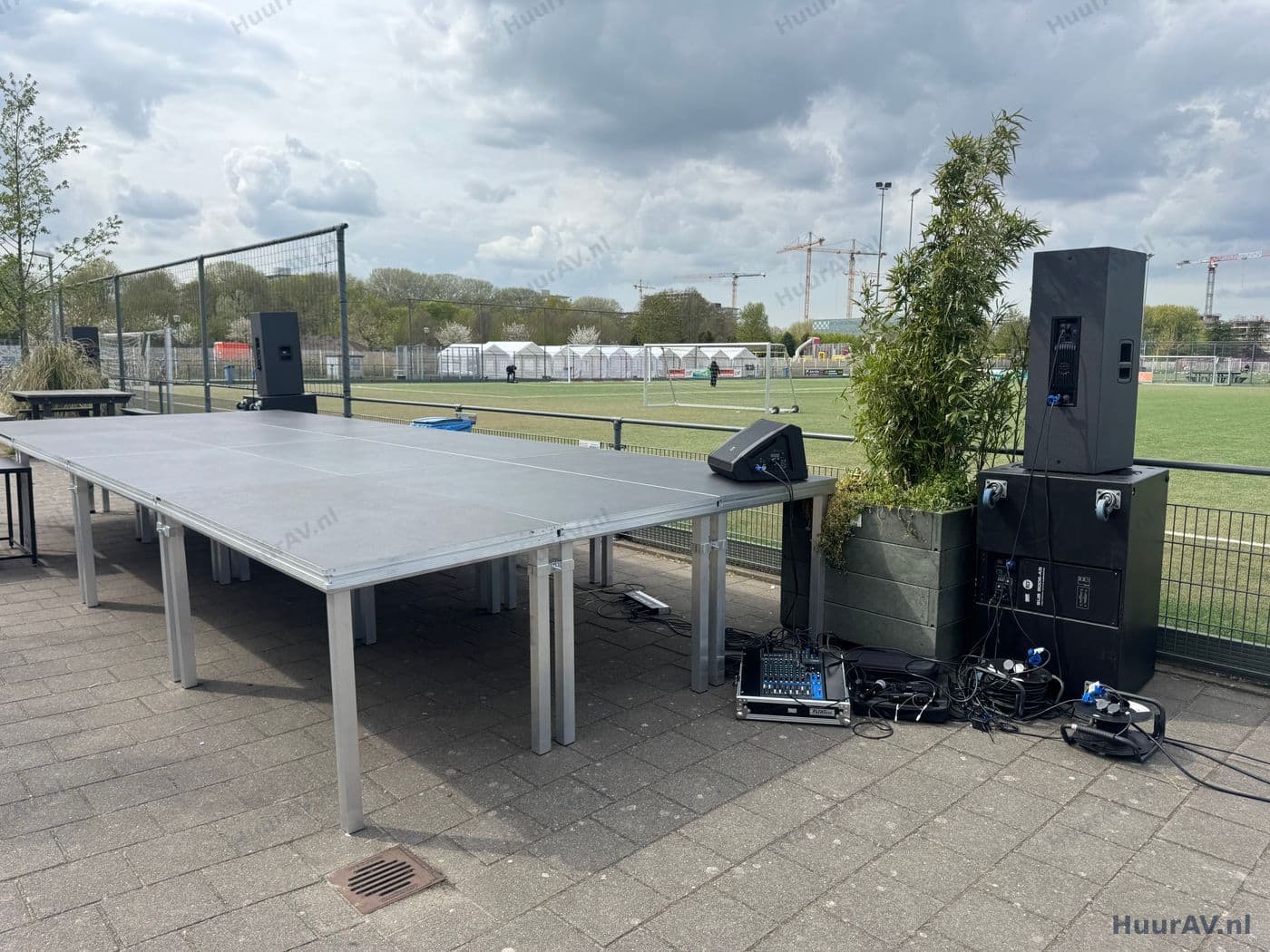
What is an amplifier?
An amplifier, in full a power amplifier, is the device that converts the weak sound signal from a mixing desk into a powerful signal that can drive loudspeakers. Passive loudspeakers, that is loudspeakers without built-in electronics, cannot make sound without an amplifier. The amplifier delivers the power, the loudspeaker converts it into sound waves. Together they form the core of every larger sound system.
It is the least visible part of a sound system, usually tucked away in a rack at the side or behind the stage, but it is decisive for the quality. An amplifier that delivers too little power lets the sound distort and sound weak at higher volumes. An amplifier that is not well matched to the loudspeaker can even damage it. The art lies in the right ratio: enough power with headroom, precisely suited to the loudspeakers. HuurAV uses separate amplifiers for larger systems and permanent installations, and makes sure the matching is right so the sound stays tight and controllable under all conditions.
What do you use an amplifier for?
Separate amplifiers belong with the larger and more demanding sound systems. At a party or company party in a large hall, where the music has to fill the whole room and firmly support the dance floor, separate amplifiers deliver the power needed for that. Subwoofers for the deep low end, for example, call for a fair amount of power, and that is most efficiently arranged with separate amplifiers.
At a corporate event or conference in a large hall, where the sound has to carry over a large distance, the combination of passive loudspeakers and central amplification forms the backbone of the system. Amplifiers also prove their worth at an event outdoors, where no walls reflect the sound and more power is therefore needed. For line arrays that distribute the sound across the depth of a large room, central amplification is likewise the standard. It is always about situations where you need power, control and reliability at a scale that active speakers do not offer.
Why passive with separate amplification
For large systems people deliberately choose passive loudspeakers with separate amplifiers. The power is managed centrally, the amplifiers are cooled and maintained in one place, and the loudspeakers themselves stay lighter because they contain no electronics. On top of that you can distribute the power precisely across the different parts of the system, for example more to the subwoofers and less to the top speakers. That flexibility is an important advantage for large productions.
The technology behind amplifiers
With amplifiers it comes down to the right ratio between power and load. Each loudspeaker has a certain power it can handle and an impedance, a kind of electrical resistance, that has to suit the amplifier. Connect too many loudspeakers to one amplifier and it can become overloaded. Deliver too little power and the amplifier starts to distort at high volumes, which both sounds ugly and is harmful to the loudspeakers. HuurAV calculates these ratios carefully, so each part of the system gets the right, stable power with enough headroom.
Heat is also a point to watch. Amplifiers that work hard get warm, and in an enclosed rack that can build up. We ensure enough cooling and ventilation so the amplifiers keep performing stably even during a long programme. The power supply is a delicate matter too: a large system draws considerable power, and the location has to be able to deliver that stably. We map that out in advance so no power fails during the event. You can read more about our wider approach on the page about sound.
Protection and reliability
Modern amplifiers have built-in protections against overheating and overload, but those are a safety net, not a design. The real work lies in the right matching in advance, so the protections never have to intervene. For large productions we keep spare amplifiers on hand where needed, so a single problem never brings the sound to a standstill. That way the system stays reliable all evening.
Signal processing before the amplifier
Between the mixing desk and the amplifiers a good system often has a stage of signal processing that distributes and protects the sound. Here it is decided which frequencies go to the subwoofers and which to the top speakers, so each loudspeaker only gets the part of the sound it is made for. Limits are also set here that prevent a peak in the music from overloading the loudspeakers. HuurAV tunes that processing to the specific loudspeakers and amplifiers in the system, because the settings have to suit exactly what the equipment can handle. A wrongly set distribution lets the sound come across dull or shrill and can cause damage, while good matching ensures a tight, balanced whole that stays under control even at high volumes. This invisible layer is an important part of why a professionally built system sounds better and more reliable.
Setup, matching and operation by HuurAV
At HuurAV you rent amplifiers with the knowledge they require, because matching amplifier and loudspeaker determines the end result. We calculate the power needed based on the loudspeakers, the room and the desired volume, and put the system together accordingly. On the day itself we set up the racks, connect the loudspeakers, check the power supply and cooling, and test the complete chain for stability and tone.
Because the right matching is a delicate matter, we recommend support from a technician who sets up the system and watches it during the event. If you still choose individual equipment that you collect and connect yourself, that is possible through SpeakerVerhuur.nl. That way HuurAV handles the advice, the setup, the testing and the operation, while rental without support is possible through SpeakerVerhuur.nl. HuurAV is part of Speaker Verhuur Amsterdam. Request a no-obligation quote.
Renting amplifiers rental
When do I need a separate amplifier?
With passive loudspeakers, which have no amplifier of their own on board. Active speakers have the amplifier built in and do not call for a separate one. For larger systems with passive loudspeakers, such as line arrays or permanent installations, you deliberately choose separate amplifiers because they offer more power and flexibility.
How much power do I need?
That depends on the loudspeakers, the size of the room and the desired volume. Too little power gives a weak, quickly distorting sound, too much can damage the loudspeakers. We calculate the right ratio between amplifier and loudspeaker, so you get a stable sound with enough headroom.
Why not just use active speakers?
For smaller events active speakers are often more practical. For large systems separate amplifiers offer advantages: you can manage power centrally, cool the amplifiers in one place and keep the loudspeakers lighter. For permanent installations and large productions the combination of passive loudspeakers and separate amplifiers is therefore common.
Can I rent amplifiers without support?
Individual amplifiers that you collect and connect yourself are arranged online through SpeakerVerhuur.nl. Because matching amplifier and loudspeaker is a delicate matter, we recommend support. If you want HuurAV to calculate the power, match everything, set up, test and operate it, we handle that on a quote basis with technicians.
Renting amplifiers rental for your event?
Tell us what you are organising. We advise, deliver, build and operate on location, or you rent it yourself through our webshop.